
Entries Tagged as ''

Imbibe Magazine

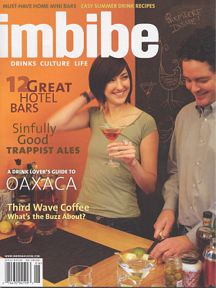
ImbibeIn case you haven’t picked up the news from Slashfood or one of the other blogs this has been floating around, there’s a new drinks mag that should be showing up on newsstands and in bookstores around the country in the next few days. Imbibe is a bi-monthly focusing on beverages across the board, and is published in Portland, Oregon. Here’s what the publisher has to say:

Imbibe is the magazine of liquid culture. It is a completely new way of looking at drinks—as a distinct culinary category, deserving in-depth exploration of history, ingredients, preparation, artistry and consumption. Imbibe will entertain and educate you about the far-reaching world of drinks, from wine and spirits to beer, coffee, tea and everything in between. This is a magazine that explores the impact drinks have on our lives—socially, politically, culturally and artistically—while highlighting the common thread people around the world share in the act of drinking. Imbibe serves up compelling travelogues, profiles and commentary, but it maintains a practical edge dedicated to helping you make informed buying decisions and enjoy drinks at home. Imbibe is your definitive and indispensable guide to all that’s fit to drink.

Although the magazine doesn’t officially debut until Monday, May 1, yesterday I found a newsstand in Pike Place Market that seems to have jumped the gun by a few days. Imbibe has a great layout–big, full-color photos printed on good-quality paper, with articles that range across the spectrum of everything liquid. Features in the debut issue include an article about Oaxaca, where writer Rivers Janssen tries everything from horchata to Mexican chocolate to agua de jamaica to single-village mezcal; a look at 12 hotel bars, ranging from Portland, Oregon, to Miami, New York and Houston, by senior editor Kate Darling; a story on organic wine, by Otis Rubottom; a story on the “third wave” of coffee, emphasizing the growing specialization of coffee (and including coverage and a photo of my favorite local coffeeshop, Victrola), by Richard Reynolds; and a story on monk-brewed beer (not surprisingly, much of it is Belgian), by Christian DeBenedetti.

Spirits- and cocktail-wise, there’s a lot in here, as well. Short department articles cover subjects such as a new tequila bearing the image of Frida Kahlo and a short profile of Wayne Roemhildt, a Minneapolis bartender. Short features (two- or three-pages long) include coverage of portable minibars; a look at Pegu Club, also by Kate Darling; and a story about bitters, by Katie Shimer.

There’s also a profile, replete with snazzy photos, of Ted “Dr. Cocktail” Haigh, written by…well, that’d be me.

It’s about time that a drinks-oriented magazine–something that ranges beyond just wine–has its chance in the spotlight, and it seems like Imbibe is stepping up to the challenge. Starting next week, you should be able to pick up a copy at Barnes & Noble, Borders, Whole Foods and a number of other outlets. Or, to make it easier (and to help the magazine gain a footing early-on), you could just subscribe.

One More Drink with Pastis and Then I’ll Shut Up

Before I settled on the Asylum for my Mixology Monday drink, I was batting around the idea of posting this one. It’s actually a much tastier drink, and after I became enamored of the whole Seabrook story, I resolved I’d come back around to this one, just so I could post a really engaging pastis cocktail. So, before I completely forget about it, here’s a pastis-containing drink that’s worth trying at least once.

I’d just shout out the name, but the problem is, the drink has two of them. But given the names and all they imply, I’d estimate the drink to be a product of the turn of the last century. I first came across it in Charles H. Baker, Jr.’s The Gentleman’s Companion, where he refers to it as

REMEMBER the MAINE, a Hazy Memory of a Night in Havana during the Unpleasantnesses of 1933, when Each Swallow Was Punctuated with Bombs Going off on the Prado, or the Sound of 3″ Shells Being Fired at the Hotel NACIONAL, then Haven for Certain Anti-Revolutionary Officers

["Remember the Maine," of course, was the jingoistic rallying call to arms in 1898, following an explosion aboard the USS Maine which was blamed (using dubious evidence) on Spain, and led to the Spanish-American War--kind of like the WMD situation of its day. In cocktail circles, the war also led us to the Daiquiri and the Cuba Libre--and, arguably, the whole panoply of pre-Castro Cuban drinks--but those are for other posts.]

The other source for this drink is Albert Stevens Crockett’s Old Waldorf Bar Days, which refers to it as “McKinley’s Delight.” Crockett wrote,

Just why it was McKinley’s delight, I am unable to ascertain. The chances are that President McKinley never found out whether it was or not. In its favor, I may mention that the Bar was a great hangout for the G.O.P.’s of yesteryear, who may have passed their emotion for their candidates across the counter for the barkeep to translate into terms of liquid intensity.

Partisan political issues aside, the drink certainly stands its claim to liquid intensity. Basically a rye Manhattan, seasoned with a little cherry brandy (the sweet stuff, like Cherry Heering, not the dry kirschwasser) and a little absinthe (or the like), this cocktail has a flavor in which neither the brandy’s fruitiness or the pastis’ elegant funk take over. Pastis, put in its place.

Remember the Maine, or McKinley’s Delight

  • 2 ounces rye whiskey
  • 3/4 ounce sweet vermouth
  • 1 to 2 teaspoons Cherry Heering
  • 1/2 teaspoon absinthe or legal substitute

Stir with ice–”briskly in clock-wise fashion–this makes it sea-going, presumably!” writes Baker–then strain into chilled cocktail glass or saucer champagne glass. Twist a curl of lemon peel over the drink.

MOTAC in Vegas

There’s a lengthy story in today’s Los Angeles Times about the Las Vegas debut of the Museum of the American Cocktail. Lots of quotes from Ted Haigh, Dale DeGroff and Tony Abou-Ganim, along with recipes for drinks such as the Gin-Gin Mule and the Brandy Crusta 21.

Read the Golden Age of Cocktails.

Mixology Monday I Roundup: Pastis

Excellent!

Mixology Monday IThe inaugural Mixology Monday turned out better than I’d expected. Eight bloggers, ranging from Portland to Madrid, participated in today’s event, posting notes about their experiences with the French anise-flavored liqueur, along with drink recipes, cultural info and a few reasons why the whole flavor of pastis just gives them the willies.

Massive thanks to everyone who participated, or who read the posts and vicariously enjoyed our drinking. I’ve put together summaries of each post below, with links to each of the sites. Did I miss anyone? If so, let me know in the comments and I’ll take care of it.

  • First out of the gate (or in my in-box, anyway), was Rick at Kaiser Penguin. Rick falls into the “I used to hate anise, but now it’s kinda grown on me” category, due mainly to an intense effort on his part to cozy up to the once-loathesome flavor. Rick shares the recipe for the Calcutta (listed as the Balloon Cocktail in Baker’s Gentleman’s Companion), a mix of equal parts rye, pastis and sweet vermouth, with a little orange bitters to make it interesting and some egg white to give it body. Check out Rick’s experience in his Mixology Monday post.
  • Bunny HugComing up next is Slakethirst, a Portland-based cocktail enthusiast who found little worth getting enthusiastic about with his chosen drink, the Bunny Hug. As with Rick, Slakethirst shares a recent revulsion for all things anise, which has only been overcome thanks to the mystical properties of Sazeracs. Taking the principles of Iron Chef as his guidance, Slakethirst searches for a cocktail in which the full presence of pastis is evident–much to his regret. Ignoring the wisdom of Harry Craddock, Slakethirst presents the Bunny Hug, composed of equal parts gin, whiskey and pastis, and named for a slow-grind ragtime dance. Check out his experience–along with much more fascinating info–in his Bunny Hug post. (Bunny Hug image borrowed from Slakethirst)
  • Did I say Sazeracs? Of course, the Sazerac is possibly the greatest anise-containing cocktail ever made, and thankfully Jimmy Patrick over at Jimmy’s Cocktail Hour dedicated his Mixology Monday post to this venerable New Orleans concoction. Jimmy–another reformed anise-hater–explains why rye just works better than bourbon in a Sazerac, and prefers his made with just Peychaud’s, no Angostura. Check out the details in Jimmy’s Sazerac post.
  • Pastis Henri BardouinAs promised, Darcy explored the flavor of the premium Pastis Henri Bardouin over at The Art of Drink. After a brief history and description of pastis (with the helpful pointer that, despite its pronounced flavor, pastis is about so much more than simply anise), Darcy suggests two drinks from pastis’ native region, the South of France, which present ways to explore and enjoy the liqueur: the Perroquet (or “parakeet”), with pastis, creme de menthe and mineral water; and the Momisette (“tiny mummy”), with pastis, orgeat and sparkling water. Check out Darcy’s full pastis post for all the details. (Bottle image borrowed from Art of Drink)
  • While Darcy explored a fine French pastis, Michael Dietsch tried an exceptional pastis called Charbay, from California’s Napa Valley. Experimenting with a new pastis–especially one from a different geographic region than the one ordinarily associated with that drink–can sometimes be dicey, but Michael was guided by the expert hand of LeNell Smothers, a renowned spirits expert and merchant in the Red Hook section of Brooklyn. Using Charbay, Michael and his wife, Jen, try three drinks: La Tomate, with pastis, grenadine and water; La Feuille Morte, adding mint syrup to la tomate; and the Dempsey, with pastis, gin, Calvados and grenadine. Read Michael’s full experiences in his Mixology Monday post.
  • Taking things in a different direction, Dave Currie reports from Madrid on the daily drinking life of the Spanish working class. Beginning with a strong coffee in the morning mixed with a shot of orujo, and continuing through the lunchtime vino con Casera and the afternoon cubata, alcoholic drinks are a part of the worker’s daily existence (and, as Dave points out, sometimes work even gets done). For Mixology Monday, Dave presents the Sol y Sombra, a mixture of brandy (preferably Spanish sherry brandy) and anis–a warming, fortifying midday drink meant to prepare you for a day of outdoor labor. Dave’s got a great post; be sure to read it in full.
  • Continuing the international theme, Chris over at Boston Cocktails tries a drink with the Greek anise-flavored spirit, ouzo. Chris admits he’s still acquiring the taste for anise–plenty of company here–and offers his recipe for an Anise Rickey. Check out Chris’ post for the details.
  • Finally, there was my post about adventurer/writer/drunkard William Seabrook, who was treated for alcoholism in a mental hospital in 1933, then embarked on a short-lived spell of sobriety marked by his publication of the tell-all book, Asylum, and contribution of a drink recipe for the Asylum Cocktail to a 1935 novelty bartending guide called So Red the Nose, or Breath in the Afternoon.

Thanks again to everyone who participated. Next up: Mixology Monday II on May 8, hosted by The Art of Drink, where the subject will be: Coffee.

See you there–

Mixology Monday I: Pastis

Mixology Monday II struggled a bit with the whole “pastis” idea. I enjoy the flavor of anise, and like the flavor in cocktails, but when looking for a pastis-containing drink that had an agreeable taste, and that had a decent story, I kept running into dead-ends.

Then I came across the cannibals.

William Seabrook was an old-school adventurer. A Maryland native, Seabrook fought for the French army during World War I (and was gassed at Verdun), then started a career as a newspaper reporter. After a few years writing for Hearst papers, Seabrook embarked on a freelance career, writing for publications including Vanity Fair and Reader’s Digest, and quickly earned a reputation as an intrepid traveler who would venture into the unknown for months on end, go deep with the locals, and come back with an incredible story.

William SeabrookHis first book, Adventures in Arabia: Among the Bedouins, Druses, Whirling Dervishes & Yezidee Devil Worshippers, was published in 1928 (and republished as recently as 1991). The Magic Island, an account of his months spent in Haiti–during which Seabrook became possibly the first journalist to witness and document voodoo rituals in the island nation’s cities and remote villages–followed in 1929. In 1931, Seabrook shocked readers with Jungle Ways, in which he documented his journey across Africa, from Ivory Coast to Timbuktu, at one point spending several months living with cannibalistic tribes and, he claimed, once dining on human flesh (a claim he later withdrew, after realizing years later that his hosts–possibly repelled by his distasteful display of enthusiasm–had probably duped him with a meal of roast gorilla*). Throughout these travels and the popular books they spawned, Seabrook revealed himself to be a keen student of anthropology, with a special interest in native religion, mysticism, sorcery and magic.

Seabrook’s adventures and success as an author earned him access to intriguing circles in Paris and New York. He counted the photographer Man Ray among his friendly acquaintances, and the noted occultist Aleister Crowley was one of his closest friends (and, later, one of his most bitter enemies). Reporter, adventurer, writer, sorcery aficionado and self-professed sadist and masochist, Seabrook was a complicated man.

He was also a world-class lush.

In the early 1930s Seabrook was, by his own estimation, knocking back a quart to a quart-and-a-half of Scotch, gin, brandy and Pernod every day. By 1933, disgusted that he had become a drunkard of the tumbler-of-whiskey-before-getting-out-of-bed variety, Seabrook and his friends decided he needed serious help. On December 4–the night before Prohibition was repealed– Seabrook sought treatment for chronic alcoholism and had himself committed to an insane asylum in Westchester County, north of New York City. He stayed there for seven months, a lone souse in a ward full of schizophrenics, manic-depressives, catatonics and hysterics. He recounted his experiences in 1935 in Asylum, perhaps the first published inside account of a patient in a mental institution, and a milestone in the literature of the treatment of alcoholism. A mild bestseller, Asylum was reprinted in several pulp paperback editions through the 1960s.

AsylumSeabrook’s treatment took place at a time just after straightjackets and handcuffs had been removed from regular use, but his experience was still quite severe. After sleeping off his final drunk, Seabrook was examined by doctors, shaved, and then taken to be bathed.

[…]A fireman stood behind two hoseless nozzles, mounted on a fireboat pedestal with dials and gauges. They stripped me and stood me against the wall where I’d make a fine target, with bars to cling to, so that I wouldn’t be knocked down. They gave it to me, first hot, then cold, then hot and cold together. I let out several loud howls, and they laughed. I didn’t know whether I was howling because I enjoyed it or because I was outraged. It hit you sometimes like a fist. It was like having a barroom fight with the Johnstown flood.

After being bound to his bed with layers of wet sheets while he sweated through the DTs, Seabrook gradually settled into life in the institution. He made friends with the other patients; squabbled with the staff (particularly over the subject of prunes), and, eventually, came to believe he was completely cured of his chronic alcoholism.

Following his discharge, and the publication of Asylum, Seabrook did the only sensible thing for a recently reformed drunk: he contributed a drink recipe to a novelty cocktail manual.

So Red the NoseSo Red the Nose, or Breath in the Afternoon is a 1935 compilation of 30 cocktail recipes (each accompanied by an illustration, several–including the one for Seabrook’s page–blatantly offensive in a racial-and-ethnic-charicature kind of way), submitted by some of the leading authors of the day. Participating authors included Erskine Caldwell, Edgar Rice Burroughs, Theodore Dreiser and Ernest Hemingway, who contributed perhaps the book’s most famous concoction, Death in the Afternoon, his legendary absinthe-and-champagne gloom-lifter. Seabrook’s drink was the Asylum Cocktail, which, as he described, can “look like rosy dawn, taste like the milk of Paradise, and make you plenty crazy.”

Composed of equal parts gin and Pernod, with a touch of grenadine for color, the Asylum resembles no dawn I’ve ever seen, unless it’s one I’ve forgotten due to the preceding evening and its resulting alcohol fog–which probably explains where Seabrook’s description comes in. The Asylum isn’t the best pastis-containing cocktail out there, but it’s also not the worst. When something comes recommended from a man with a hankering for human flesh and a habit of hobnobbing with devil-worshippers, it sometimes pays to experiment a little. But caution is warranted: as the editors of the volume note, “Members of So Red the Nose Club should read Asylum to discover what lies in store for incautious imbibers of Gin and Pernod.”

Asylum Cocktail

  • 1 1/2 ounces gin
  • 1 1/2 ounces Pernod
  • 1 teaspoon grenadine

In a rocks or Old Fashioned glass, build the grenadine, Pernod (or other anise-flavored liqueur) and gin, in that order; do not stir. Gently add ice; watch as the cocktail changes colors. Eventually drink.

[Oh, and Seabrook? A lush for life, as he relates in his autobiography, No Hiding Place, published in 1942, two years before he took his own life with an overdose of sleeping pills.]

When mixing the Asylum, or any other cocktail calling for a pastis or absinthe substitute, there are a range of available options. Pernod, the most popular anise-flavored liqueur, works quite well in these drinks–though, with its grape-alcohol base, Pernod is technically not a pastis (by definition, pastis is made with a neutral alcohol base; but what the hell–Pernod works, and it’s easy to find).

It’s worthwhile to venture beyond the most familiar products on the shelf. Thanks to Murray at Zig Zag, I had the chance to sample a few true pastis last week. My favorite of the group was Granier, which had an assertive anise aroma yet was soft and well-rounded in flavor, slightly sweet, and retained its character when mixed with water. Others, such as the more-familiar Ricard–which presented the sweetness first and the anise in a short, coarse burst afterward–and La Muse Verte–an unsweetened pastis that tasted crisp and bright neat, with a touch of bitterness, yet folded quickly when mixed with water–fell further down on my list.

* UPDATE: Promoted from the comments section, Adam Thornton helpfully points out that Seabrook did consume human flesh–though not with the African tribe, as he initially thought, but rather, later on, in Paris. Realizing he lacked the necessary experience to write about cannibalism, Seabrook convinced a friend at a morgue to give him a piece of flesh from an accident victim, then carefully prepared it in his kitchen, documenting every step.

Read Adam’s comment and follow the link to get the full, um, flavor of Seabrook’s endeavor. And if you’ll now excuse me, I have a topic to propose over at “Is My Blog Burning?”


  • The Cocktail Chronicles is part of the Cocktails & Spirits Ad Network. To advertise on this site or across a network of cocktail and spirits related weblogs, click here.
  • Subscribe via e-mail

    Enter your Email


    Preview | Powered by FeedBlitz
  • Etcetera

  • Foodista Drink Blog of the Day Badge
  • Powered by Laughing Squid
  • hit counter
  • Alcoholic Blog Directory