
Entries Tagged as 'Rye'

The PDT Cocktail Book

If last night’s Twitter traffic is any indication, I missed a hell of a party.

That’s to be expected. I’m home in Seattle, while the party in question — that for the release of Jim Meehan’s The PDT Cocktail Book – was, obviously, in New York, the way many of the parties I’m really envious of missing seem to be.
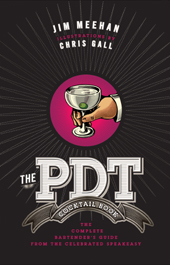
But the celebration was certainly justified. In addition to being one of the world’s more talented and influential barmen, and co-owner of one of the core bars in the craft-cocktail universe, Jim Meehan is now author of a cocktail guide that’s bound to be so definitive of a mixological moment and so influential for bartenders current and future that I can only agree with Gaz Regan (while conveniently stealing his words) that the PDT book is “the best book of its kind to hit the shelves in the twenty-first century. The very best. Bar none.” (Thanks for the help, Gary!)

Okay, details: there are more than 300 recipes in this book, all sourced from assorted manifestations of PDT’s menu. There are a few familiar classics of the Monkey Gland and French 75 variety, but where Meehan’s book not surprisingly shines is in its wealth of contemporary recipes, many from Meehan and his colleagues and associates, for drinks such as the hibiscus-and-tequila Green Harvest; Don Lee’s Rite of Spring, made with pickled ramp brine; and the apple brandy and beer-based Great Pumpkin.
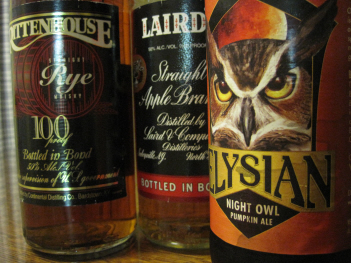
I first tried the Great Pumpkin at PDT three years ago, and I brought a happy, hazy memory of this rich autumnal drink home with me. I got a chance to run a recipe for this drink in the San Francisco Chronicle about two years back, and now that the stores are once again flooded with pumpkin ale –something I have a hard time getting too enthusiastic about, except when it’s a component in mixed drinks such as this one — it’s a suitable time to take a look at the Great Pumpkin again.

Great Pumpkin
created by Jim Meehan, Fall 2008

  • 1 oz. Rittenhouse rye whiskey
  • 1 oz. Laird’s bonded apple brandy
  • 1/2 oz. grade B maple syrup
  • 1 whole egg, as fresh as possible
  • 2 oz. pumpkin ale*

Combine everything in a cocktail shaker and agitate to flatten the beer (it helps if you add the beer first, then splish it about to drive out all the bubbles so your shaker won’t pop open and spray booze and eggs all over the place). Shake well without ice to fully combine the ingredients, then add ice and shake like hell for 10 seconds. Strain into chilled fizz glass; top with grated nutmeg.

* Meehan recommends the pumpkin ale from Southampton; being in the PNW, I went with Elysian’s pumpkin ale, which worked pretty well.

The Great Pumpkin has a complexity of preparation that’s pretty much par for the course in the PDT Cocktail Book. While some of the book’s drinks call for bespoke ingredients — from simple preparations like house ginger beer or walnut-infused cognac, to more complicated items such as concord-grape shrubb, or tamarind puree — or for unusual ingredients that can take some work to track down, such as Boiron passion fruit puree or Abbott’s Bitters (though there are replicas now floating about), many of the drinks are relatively straightforward. Meehan frequently calls for particular brands of certain spirits or modifiers, which can be challenging if you intend to prepare that drink exactly according to the specifications, but if you exercise some flexibility with substitutes while keeping the drink’s final flavor in mind, a cocktail enthusiast with a reasonably well-stocked home bar should be able to tackle most of the book’s recipes.
And the drinks? Extraordinary. PDT has built a reputation as one of the world’s best bars not just because you have to go through a phone booth to get there and can get a hot dog with your Blood and Sand — the drinks developed by Meehan and his staff, which has included formidable talent such as Don Lee and John Deragon, are big in flavor, distinctive in character and reliably fantastic.

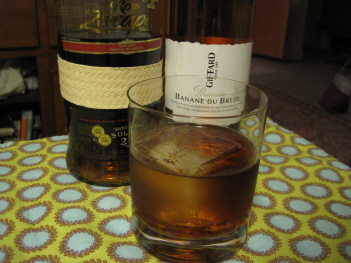
Here’s a very simple drink from Meehan that I mixed last weekend, and enjoyed very much: the Platanos en Mole Old Fashioned.

Platanos en Mole Old Fashioned

  • 2 oz. Zacapa 23 Centenario Rum*
  • 1/4 oz. Brizard Crème de Banane**
  • 12 drops Bittermens Xocolatl Mole Bitters

Combine ingredients in a mixing glass and fill with ice. Stir well until chilled, 20 seconds or so, and strain into a rocks glass with one large cube of ice. Garnish with a pinch of ground chili.

* Did I say be flexible? Zacapa works really well here, but if you absolutely have none in the house but you do have some Zaya lying around, it’ll get you there.
** More on flexibility—the only banana liqueur I have is Giffard Banane du Bresil, which ain’t too shabby and worked just great in this drink.

Anyway, I’m already running behind the release date on getting this post up, so I’ll can further chatter and leave it to you: grab a copy of The PDT Cocktail Book, and if you have particular luck with one or more of the recipes, let me know in the comments section.

60/30, #29-30: Friday = rye whiskey

It’s Friday at the end of a busy week, in the middle of a busy month. Complexity is not what I’m looking for in terms of drink preparation right now; lots of flavor, sure, and I’m still ready to do the basic shaking and measuring and whatever the hell I have to do to get a decent drink in front of me, but on Friday evenings I don’t really feel ambitious enough to make syrups or drag a half-dozen bottles out of the liquor cabinet for one drink.

I also don’t feel ambitious enough to go into a long, elaborate post about all the crooked crannies of complicated drinks, and I doubt you’re much in the mood for reading 1,000-word blog posts about a couple of cocktails, so let’s get right to the point: here are two whiskey drinks in the sour vein that I’m enjoying quite a bit these days.

New York Sour

  • 2 ounces rye whiskey
  • 3/4 ounce fresh lemon juice
  • 1/4 ounce simple syrup (or 1 – 1 1/2 tsp. sugar, to taste)
  • 1/2 ounce dry red wine (syrah, malbec – as long as it’s not sweet or big & jammy, you’re good)

Combine whiskey, lemon and sweetener in a cocktail shaker and shake with ice. Strain into an ice-filled rocks glass or a chilled cocktail glass. Carefully pour the wine over the back of a bar spoon so it forms a neat layer atop the drink (if you like, especially if you’re serving the drink straight up, you can chill the wine first by putting it in a mixing tin and placing that tin inside a larger glass or tin filled with ice).

Nothing new about this one — as David Wondrich write in Imbibe!, the drink was making the rounds during the 1880s, sometimes known as the Continental Sour or the Southern Whiskey Sour, but the New York Sour sobriquet stuck to it around 1900 (though I’ve also seen this on menus as a Greenwich Sour, and in books as a New York or New Yorker; shrug).

There’s also no surprise about why this is in my current rotation: it’s a tasty goddamn drink. I mean, look at it: it’s just a basic whiskey sour, a drink so classically awesome that it can do pretty much everything except explain to your wife why you’ve been out until 3am, topped with a float of red wine, which has the whiskey’s back and makes what would otherwise be a humble cocktail into something comfortable around high-class company. It looks great, it tastes fantastic, and if your kitchen is anything like mine you’ve probably already got all the ingredients. What more do you need?

Well, besides a second round: here’s another whiskey drink that Michael Bauer wrote up not too long ago for the San Francisco Chronicle: the Rattlesnake, from Beretta in San Francisco.

Rattlesnake
from Beretta, San Francisco

  • 2 ounces rye whiskey
  • 1 ounce lemon juice
  • 1/2 ounce maple syrup (Grade B is what you’re looking for)
  • 2 dashes Peychaud’s bitters
  • Egg white (one egg should be sufficient for two drinks)
  • – lemon peel, for garnish

Combine ingredients in a cocktail shaker and shake well, without ice, until the egg white is good and foamy, about 10-15 seconds. Add ice and shake again another 10 seconds; strain into chilled cocktail glass. Prepare your broad twist of lemon and go in for the kill.

Again, easy as hell: a whiskey sour with maple instead of simple, rendered old school with the egg white, and with a little bitters because what the hell, Peychaud’s is welcome at pretty much any party you can come up with. The drink comes out edgy and alluring (especially if you’re using a higher-proof rye like Wild Turkey or Rittenhouse bonded), with enough oaky darkness from the whiskey to beat off the richness of the maple and the acid from the lemon. The twist finish is somewhat unorthodox for egg-white drinks, but it works; the lemon oil winds up suspended on the drink’s surface for way beyond the first sip, so the heaviness of the rumble going on beneath the foam is never allowed to fully take over.

60/30, #26-28: Quinquina all over the place

Writing about three drinks with a common element of French quinquinas may be leaping deep into cocktail geek territory, but hey — here, I’m among my people.

I’ve written in depth about the class of aperitif wines known as quinquinas a couple of times — here’s a piece from Imbibe, and another from the San Francisco Chronicle — so I’ll skip the long history lesson and get right down to the drinks.

Last spring, when Eric Seed’s Haus Alpenz began distributing two quinine-enhanced aperitif wines, much of the buzz in the blogosphere and beyond was about Cocchi Aperitivo Americano, long rumored in cocktail circles to be the best available substitute for the now-defunct Kina Lillet in drinks such as the Corpse Reviver #2 and the Twentieth Century. At the same time, though, Eric was also bringing in Bonal Gentiane-Quina; here’s what I wrote about Bonal in the Chronicle:

Produced in France since 1865, Bonal has a double-headed bitterness from cinchona and gentian. When combined with other ingredients in a base of mistelle - partially fermented grape juice mixed with higher-proof alcohol – its character is simultaneously juicy and bone dry.

If there’s a takeaway lesson I try to work in every time I write or talk about quinquinas, it’s that these aperitif wines are NOT simply a kind of vermouth. Similar, yes, in the way that Maker’s Mark is similar to Glenrothes in that they’re both grain-based spirits aged in oak barrels, but simply lumping Dubonnet or St. Raphael in with Noilly Prat is a disservice to both sides of the aperitif-wine equation, and can only be limiting when thinking about how to use these wines in a cocktail.

But instead of lecturing, as I have the habit of doing, let me show you what quinquinas can do in a cocktail, using Bonal as the running theme. We’ll start with the Bonal & Rye, from Todd Smith at Dalva in San Francisco, the recipe for which ran with my story in the Chronicle.

Bonal & Rye
from Todd Smith, Dalva, San Francisco

  • 2 ounces rye whiskey (I like Wild Turkey 101 or Rittenhouse 100, if you’ve got a stash)
  • 1 ounce Bonal Gentiane-Quina
  • 1/2 ounce Cointreau
  • 2 dashes orange bitters
  • 1 dash Angostura bitters
  • – Orange twist, for garnish

Stir with ice, strain into chilled cocktail glass, give it a good twist of the orange peel and use it as garnish

Between the Cointreau and the orange bitters (I used Angostura orange), this is like an uber-citrusy Manhattan. The difference, however, is that while a Manhattan would have a bit more sweetness and a herbaceous finish, thanks to the vermouth, Bonal brings its juicy/dry characteristic — it lends just enough bitterness to keep this cocktail on the dry side (even with the liqueur along for the ride), but it’s not an astringent bitterness — it’s akin to biting into a bunch of grapes, stem and seeds and all, so there’s a vibrant mix of bitterness and bright juice that makes everything balance out. A very worthwhile Manhattan relative (even if it’s a distant cousin, twice-removed).

I was in San Francisco in October, and while I didn’t have a chance to visit Dalva, I was introduced to another interesting Bonal drink by Jonny Raglin at Comstock Saloon. This isn’t on the menu (or at least it wasn’t at the time), and I’m not sure if it even has a name, but it’s basically a variation on a Brooklyn cocktail with a couple of little twists.

I’ve always been suspicious of the Brooklyn; for some reason, the mixture of rye or bourbon with dry vermouth has never seemed an auspicious pairing to me; the floral aspects of dry vermouth always seem discordant with the rich oakiness of the whiskey, and except for the Algonquin Cocktail (which complicates the matter with the addition of pineapple juice), I can’t think of another whiskey + dry vermouth drink I’ve particularly enjoyed.

Jonny remedied this clash by discarding the vermouth in favor of dry sherry — in his case, Lustau Palo Cortado, which is kind of a midway sherry between the bone-dry fino and the richer, nuttier amontillado. Also, since one of the Brooklyn’s signature ingredients, Amer Picon, is still a rarity in the U.S., Jonny swapped it out for Bonal and added a dash of orange bitters, so there’s still a little citrus ting to the drink along with a dry bitterness.

RECIPE NOTE: I didn’t get Jonny’s measurements from him, so I’m working with a classic Brooklyn recipe with the ingredient substitutions kept at the same proportions; it didn’t taste weird when I tried it, so hopefully I’m in the ballpark.

Brooklyn variation
by Jonny Raglin, Comstock Saloon, San Francisco

  • 2 ounces rye whiskey (I used Wild Turkey 101)
  • 3/4 ounce palo cortado sherry*
  • 1/4 ounce Bonal Gentiane-Quina
  • 1/4 ounce maraschino liqueur
  • 1 dash orange bitters
  • –orange twist, for garnish

Stir with ice, strain, twist & garnish.

* After 15 minutes of searching, I gave up on finding that bottle of palo cortado I bought and squirreled away somewhere, waiting for the right time to open it. Instead I used oloroso — I know, not the same, but hey — and the drink was still quite tasty, with more of that brown-butter nuttiness you get from the bigger-tasting sherry. In hindsight I should have mixed half oloroso with half fino, but I wasn’t really thinking at the time.

This Brooklyn variation is much more to my taste; the sherry’s nuttiness fits way better with rye than dry vermouth ever does, in my opinion, and the drink was dry but still rich-tasting, as opposed to a standard Brooklyn’s tangy florals. I’ll go with this version anytime.

One other drink I’d gathered for the Chronicle piece, but wound up not using for reasons of space, is an adaptation of a classic Quinquina Cocktail, the renovated version developed by Chantal Tseng from Tabard Inn in Washington, D.C. Chantal says she initially found the recipe in Trader Vic’s Bartender’s Guide from 1947, but that it also appears in “Cocktail Bill” Boothby’s World Drinks and How to Mix ‘Em from much earlier in the century. This tweaked version may be my favorite of the three drinks in this post.

Quinquina Cocktail (variation)
adapted by Chantal Tseng, Tabard Inn, Washington, D.C.

  • 1 ounce brandy
  • 1/2 ounce apricot liqueur (Rothman & Winter suggested)
  • 3/4 ounce Bonal Gentiane-Quina
  • 2 dashes Pernod (I substituted absinthe)
  • –lemon peel, for garnish

Stir well with ice, strain into chilled cocktail glass, give it the lemon peel treatment.

This is really, really good — the plushness of the brandy and liqueur are offset just enough by the dryness of the Bonal. The quinquina’s bitterness is almost completely dispelled by the other ingredients, except for a light, lingering back-palate finish that reminds you that you did, indeed, have some quinine in there somewhere. I’d like to try this with a good peach liqueur, or perhaps pear; perhaps once I’m done with this 60/30 thing, I’ll have time to take this kind of scenic detour.

60/30, #17-18: Two not-too-scary drinks from Jim Romdall

Before I even asked Jim Romdall from Vessel if he’d let me rip off a couple of his recipes for this month-long blog frenzy, I knew whatever drinks he prepared would have some ingredient guaranteed to freak out about 90 percent of the drinking public. I mean, look at the facts: the man’s Twitter handle is @ardbegfloat, he entered a cocktail in a vodka contest that mixed the obnoxiously toothpaste-esque 42 Below Feijoa with (if my fuzzy memory serves) green Chartreuse and Bowmore (and actually made a pretty interesting drink out of it), and who’s been known to deploy both absinthe and Caol Ila in a gin-based cocktail.

Jim’s also a good sport and even after I told him that these drinks were to be featured on a blog, and not in print or anything real or sexy like that, he still played along. And while I was a little disappointed that no Islay malts made their way into the mix — really, I was fully prepared to exit Vessel smelling like my coat was on fire — Jim did indeed go there with the buckets-of-knuckles ingredients, preparing both drinks with Fernet Branca, and one of them with white dog.

Here’s where he went:

Industry Sour

  • 1 1/2 ounces cognac
  • 3/4 ounce Fernet Branca
  • 3/4 ounce lemon juice
  • 1/2 ounce lime juice
  • 1/4 ounce agave nectar
  • 1 egg white
  • Angostura bitters, for garnish

Combine everything except the bitters in a cocktail shaker. Dry shake for a good 10 seconds to work up the egg white, then add ice and go at it again. Strain into chilled cocktail glass; drip Angostura atop the foam and swirl it into pretty pictures if that’s what you like to do with your time.

Jim actually prepared this for me using Calvados, which was an interesting detour but as he said and I agree after trying the drink again at home, you really want the soft, fruity richness of grape brandy for a platform upon which the Fernet and the citrus can play.

Speaking of the Fernet: as anybody who’s ever mixed a drink with it knows, putting Fernet Branca in a cocktail shaker with other ingredients can be the rough equivalent of feeding crystal meth to a pit bull and putting it in a room full of bunnies: the results are bloody, messy and frighteningly savage. There are a few things that can partially defang Fernet, though; one, as I’ve mentioned, is a whopping dose of vermouth, but others include egg white, which helps soften and spread out the bitter impact, and citrus — well, the citrus is like distracting the tweaking dog by hitting it with a pillow while the surviving rabbits run for cover: it doesn’t so much soften the Fernet’s bite as much as it provides another aspect of the drink that keeps the liqueur from fully dominating. Anyway, as might be expected, this is a big, bold, gnarly drink, but still pretty appealing if you’re into big, bold, gnarly things.

Vessel is right next to the 5th Avenue Theatre, and right now, as the holidays approach, the theater is featuring A Christmas Story: The Musical, based on the “you’ll put your eye out” movie from the 1980s. In case you’ve somehow missed catching the movie during the holiday-season heavy rotation it’s enjoyed on television over the past quarter century, there’s a key scene near the end involving a Christmas turkey and a pack of the neighbor’s dogs. Always one to support the next-door theater as well as to celebrate bad behavior on the part of animals, Jim created the next drink in their honor.

Bumpass Hound

  • 2 ounces rye whiskey (he used Pikesville)
  • 1/2 ounce unaged (or minimally aged) rye whiskey
  • 1/4 ounce Fernet Branca
  • 1/4 ounce simple syrup
  • 1 dash Angostura bitters
  • –orange twist, for garnish

Put ingredients in a mixing glass and yadda yadda if you’ve been to this blog before you know what to do. Up, cocktail glass, orange twist.

Jim initially tried this with an ounce of Headlong White Dog from the Woodinville Whiskey Co., which is made using a rye-free bourbon mashbill, and the new spirit was just too soft and sweet for this drink, so he started over with Wasmund’s Rye Spirit, cutting the dose back to 1/2 ounce compensate for the potency of this cask-strength raw whiskey (Jim says he’ll be using Corsair Wry Moon should this drink go into the regular rotation). If you’re playing along at home and don’t have any of these spirits, another (still somewhat obscure and kinda pricey) option is to use Old Potrero 18th Century Style Whiskey, which is all rye, cask strength and very lightly aged.

Now this is something. The drink is basically a Toronto Cocktail with additional gaminess provided by the young whiskey. I have to confess to a bit of white-dog fatigue; sure, it’s interesting stuff, but I rarely find myself actually wanting it in my glass. But in this drink, the young whiskey really plays a good role: it takes the potency of flavor that’s so engaging in a Toronto, and adds another dimension, giving the drink a new identity. The young rye also lends support to the base of aged rye, waking up the whiskey’s flavor, and in the process it erects an obstacle to keep the Fernet from stealing the show.

Anyway, thanks to Jim Romdall for playing along with my little blog project. Go see him at Vessel and buy a bunch of drinks.

60/30, #9, 10 & 11 – Mezcal makes the rounds

A little over five years ago, when I first started this blog, mezcal hadn’t even risen high enough in the cocktail world to be considered an afterthought. Sure, Ron Cooper had begun importing his Del Maguey single-village mezcals back in the ‘90s, but these things take time, and while tequila was in full bloom following the turn of the century, mezcal took its time to step into the cocktail-geek spotlight.

I’m running late in getting this post up, so I’ll keep it short; I’m also a couple of drinks behind on this 60/30 thing due to taking the day off for Thanksgiving, so I’ll toss in a third drink (plus, a bonus / screwup drink that’s still kinda tasty) to help move things along.

For the handful of people out there who still haven’t ventured to the artisanal mezcal well, mezcal in many ways tastes like tequila without makeup. While a blanco tequila can have flavors of peppers, slate and wildflowers, all on top of a gentle, juicy agave sweetness, mezcal is just kind of more everything – more dark spices, more jammy richness of cooked pears and baked apples, more earthy minerality, more firey, more smoky, more primal, more visceral, more grrrrr…. A single mezcal can have most, or all, or none of these characteristics, venturing out into its own part of the spirituous universe where nothing at all tastes quite the way it does.

Given its potency of flavor, not to mention its cost, perhaps the best way to slip into mezcal mixology is to use it as an accent ingredient, where its rich smoky everything can play off the other flavors in the glass without taking over the show. Here’s a drink that uses mezcal as an accent to very good effect: the Red Ant.

I wrote this up for the September/October 2010 issue of Imbibe, as part of a feature on cocktail bitters. The Red Ant was created by Thomas Waugh, then a bartender at The Alembic in San Francisco but now at Death & Co. in New York. The drink is named for the Rio Hormiga Colorada, or Red Ant River, in Oaxaca, and uses a mere barspoon Del Maguey Chichicapa in a mix that includes big, vibrant flavors from Rittenhouse 100-proof rye whiskey, Cherry Heering and kirschwasser. The mezcal hangs over the drink like a plume of smoke from a wood stove, and the combination of mezcal and kirschwasser — which brings its own ethereal drama to the mix in a big way — is really quite enchanting.

Red Ant
From Thomas Waugh, Death & Co., NYC

  • 1 1/2 oz. rye whiskey (Rittenhouse bonded; failing that, Wild Turkey 101)
  • 1/2 oz. kirschwasser
  • 1/2 oz. Cherry Heering
  • 1 barspoon mezcal (Chichicapa if you got it)
  • 2 dashes Bittermens Xocolatl Mole bitters
  • –3 cherries skewered on a pick, as garnish. Sneer all you like, but it looks like an ant; besides, I’m still kind of a sucker for Toschi Amarena

Stir well with ice & strain into chilled coupe. Stick that cherry ant in there and shut up for a while about the damn cherries.

Excellent, excellent drink — but there’s an accidental variation on this drink that I also like quite a bit. See, I first heard about this drink from Avery Glasser, who with his wife Janet is the mastermind behind Bittermens Bitters. Somewhere in talking about this drink with Avery, there was a mixup in the ingredients, and for a couple of weeks I was sampling this lovely drink using the wrong recipe. Thomas Waugh set me right, and the recipe above is the correct version; but, the “mistake” version also kinda rocked, so I’ll pass that along as well. Keep in mind that this alternate doesn’t include mezcal, so the whole “Red Ant” idea is out the window, as is the rationale for including this drink in a mezcal post, but hey, it’s just liquor.

Mistaken Ant

–same recipe as above, except substitute 1 barspoon cinnamon syrup for the mezcal; Trader Tiki Cinnamon Syrup is quite nice here

Sure, you lack the smoke and a little bit of the complexity, but cinnamon, Cherry Heering and kirschwasser, with some mole bitters in the mix? There’s nothing wrong at all with that mistake.

Anyway, the next step in mezcal mixing is often to bump up the mezcal to a full ounce or so, matching it step for step with the mediating effects of tequila. Julian Cox at Rivera in Los Angeles passed along this recipe for his Poblano Escobar, which ran last summer in Imbibe. Julian mixes the drink with mezcal or with blanco tequila; I’ve made these a few times at home, to try out each variation, and for the most recent round I used equal parts Cabo Wabo blanco (it had been sent as a sample and isn’t half bad, so I thought I’d give it a spin in this drink) and Del Maguey Mezcal Vida (not a sample, bought with my own damn cash, and at about $34 a bottle, much more affordable than the rest of the Del Maguey line).

I’ve also been guilty in the past of being dismissive of muddled ingredients, a position I still hold on a certain level because it’s so overdone, and so badly in many places, that I wish it’d be approached more seriously, but I’ve also sampled some fantastic drinks made with the “garden fresh” approach, so I’d now like to extend a cautious and respectful gesture of welcome to the muddlers of the world. In this drink, poblano peppers and pineapple are both crushed into the mix; hey, it works.

Poblano Escobar
From Julian Cox, Rivera, Los Angeles

  • 2 oz. blanco tequila or mezcal, or some combination thereof
  • 3/4 oz. Royal Combier (Julian’s call; I like it, but if you don’t have it you can sub Cointreau)
  • 1 oz. fresh lime juice
  • 1/2 tsp. agave nectar
  • 4 chunks fresh pineapple
  • 2 or 3 1/4-inch-think rings of sliced poblano chiles, seeds removed
  • 1/4 tsp. ground cumin

Muddle chiles in a cocktail shaker with lime juice and liqueur. Add pineapple, cumin and agave nectar and muddle again. Add tequila and/or mescal and load up on ice; shake well and double-strain into chilled rocks glass filled with a large cube of ice. Garnish with slices of poblano pepper and orange.

Of course, no discussion of mezcal cocktails is complete without mentioning Phil Ward at Mayahuel in NYC. I’ve written up a bunch of Phil’s drinks in the past, both online and in print, and he’s always one of my favorite bartenders to interview (though, I’m ashamed to say I still haven’t had the chance to sit across the bar from him). I have another of Phil’s drinks coming up later on, but a couple of weeks ago a Mayahuel drink called Jacko’s End (created, apparently, on the day MJ performed that moonwalk into the great beyond) was listed on Tasting Table’s list of “The Year’s Best Cocktails” for NYC. In this one, mezcal is matched against an equal measure of Laird’s bonded apple brandy — a combo I could automatically taste in my mind, with that rich body of smoky mezcal up against the sharp bite of apple brandy — fleshed out with a little Benedictine and a couple of dashes of bitters. Simple, basic, classically designed and with premium ingredients: that’s all I needed to know.

Jacko’s End
From Mayahuel, NYC

  • 1 ounce mezcal (I used Vida, for the reasons stated above)
  • 1 ounce Laird’s 100-proof apple brandy
  • 1/2 ounce Benedictine
  • 2 dashes Peychaud’s bitters
  • –pear slice, for garnish

You know the drill – ice, stir, strain into chilled glass, garnish. Like I said, simple.

Between the Benedictine and the mezcal, there’s a silky, honeyed texture to this drink. The sharpness of the Laird’s bonded and the peppery serrations in the mezcal combine in a really pleasant assertiveness in the drink, followed by the ghostly herbaceousness of mezcal-meets-Benedictine, finishing with that little wisp of smoke. This one’s going into the regular rotation.

  • Liquor.com - Your expert guide to all things cocktails and spirits.
  • Archives

  • Subscribe via e-mail

    Enter your Email


    Preview | Powered by FeedBlitz
  • Categories

  • Support