
Entries Tagged as 'Rum'

The PDT Cocktail Book

If last night’s Twitter traffic is any indication, I missed a hell of a party.

That’s to be expected. I’m home in Seattle, while the party in question — that for the release of Jim Meehan’s The PDT Cocktail Book – was, obviously, in New York, the way many of the parties I’m really envious of missing seem to be.
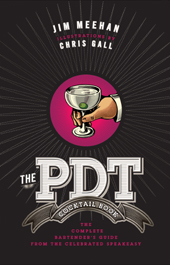
But the celebration was certainly justified. In addition to being one of the world’s more talented and influential barmen, and co-owner of one of the core bars in the craft-cocktail universe, Jim Meehan is now author of a cocktail guide that’s bound to be so definitive of a mixological moment and so influential for bartenders current and future that I can only agree with Gaz Regan (while conveniently stealing his words) that the PDT book is “the best book of its kind to hit the shelves in the twenty-first century. The very best. Bar none.” (Thanks for the help, Gary!)

Okay, details: there are more than 300 recipes in this book, all sourced from assorted manifestations of PDT’s menu. There are a few familiar classics of the Monkey Gland and French 75 variety, but where Meehan’s book not surprisingly shines is in its wealth of contemporary recipes, many from Meehan and his colleagues and associates, for drinks such as the hibiscus-and-tequila Green Harvest; Don Lee’s Rite of Spring, made with pickled ramp brine; and the apple brandy and beer-based Great Pumpkin.
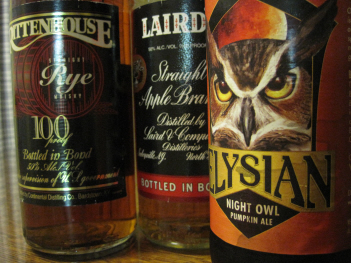
I first tried the Great Pumpkin at PDT three years ago, and I brought a happy, hazy memory of this rich autumnal drink home with me. I got a chance to run a recipe for this drink in the San Francisco Chronicle about two years back, and now that the stores are once again flooded with pumpkin ale –something I have a hard time getting too enthusiastic about, except when it’s a component in mixed drinks such as this one — it’s a suitable time to take a look at the Great Pumpkin again.

Great Pumpkin
created by Jim Meehan, Fall 2008

  • 1 oz. Rittenhouse rye whiskey
  • 1 oz. Laird’s bonded apple brandy
  • 1/2 oz. grade B maple syrup
  • 1 whole egg, as fresh as possible
  • 2 oz. pumpkin ale*

Combine everything in a cocktail shaker and agitate to flatten the beer (it helps if you add the beer first, then splish it about to drive out all the bubbles so your shaker won’t pop open and spray booze and eggs all over the place). Shake well without ice to fully combine the ingredients, then add ice and shake like hell for 10 seconds. Strain into chilled fizz glass; top with grated nutmeg.

* Meehan recommends the pumpkin ale from Southampton; being in the PNW, I went with Elysian’s pumpkin ale, which worked pretty well.

The Great Pumpkin has a complexity of preparation that’s pretty much par for the course in the PDT Cocktail Book. While some of the book’s drinks call for bespoke ingredients — from simple preparations like house ginger beer or walnut-infused cognac, to more complicated items such as concord-grape shrubb, or tamarind puree — or for unusual ingredients that can take some work to track down, such as Boiron passion fruit puree or Abbott’s Bitters (though there are replicas now floating about), many of the drinks are relatively straightforward. Meehan frequently calls for particular brands of certain spirits or modifiers, which can be challenging if you intend to prepare that drink exactly according to the specifications, but if you exercise some flexibility with substitutes while keeping the drink’s final flavor in mind, a cocktail enthusiast with a reasonably well-stocked home bar should be able to tackle most of the book’s recipes.
And the drinks? Extraordinary. PDT has built a reputation as one of the world’s best bars not just because you have to go through a phone booth to get there and can get a hot dog with your Blood and Sand — the drinks developed by Meehan and his staff, which has included formidable talent such as Don Lee and John Deragon, are big in flavor, distinctive in character and reliably fantastic.

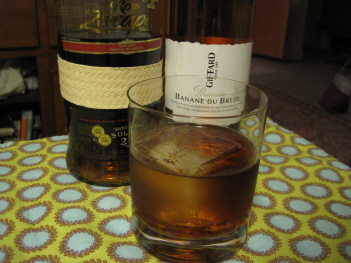
Here’s a very simple drink from Meehan that I mixed last weekend, and enjoyed very much: the Platanos en Mole Old Fashioned.

Platanos en Mole Old Fashioned

  • 2 oz. Zacapa 23 Centenario Rum*
  • 1/4 oz. Brizard Crème de Banane**
  • 12 drops Bittermens Xocolatl Mole Bitters

Combine ingredients in a mixing glass and fill with ice. Stir well until chilled, 20 seconds or so, and strain into a rocks glass with one large cube of ice. Garnish with a pinch of ground chili.

* Did I say be flexible? Zacapa works really well here, but if you absolutely have none in the house but you do have some Zaya lying around, it’ll get you there.
** More on flexibility—the only banana liqueur I have is Giffard Banane du Bresil, which ain’t too shabby and worked just great in this drink.

Anyway, I’m already running behind the release date on getting this post up, so I’ll can further chatter and leave it to you: grab a copy of The PDT Cocktail Book, and if you have particular luck with one or more of the recipes, let me know in the comments section.

11:59

Please excuse the dust — it’s been a while since I’ve been around these parts, and I haven’t had a chance to clean up.

On what’s become a typical Monday night, I’d be perfectly content to continue ignoring this blog in favor of frittering away my time on even less productive pursuits, but today is Mixology Monday (chapter 56, if anyone’s keeping count), and considering that last month was the first time in what’s now five years of the event (happy anniversary!) that I missed posting a drink for a MxMo (thanks to a busy travel schedule and my own unshakable laziness), I thought it best not to make that a habit, as well — and so, here we are.

Not that it’s an easy theme this month. As chosen by this month’s MxMo host, Chris at Spirited Remix, the theme is “Your Best” – as in, what’s your very best original drink that you’ve ever put together. And for me, at least, the only correct answer is: I have absolutely no idea.

When it comes time to mix a cocktail, an overwhelming majority of the time, I’m totally happy to follow a beaten path — timeworn classics like the Manhattan and the Old Fashioned (along with their extended families) are such frequent visitors around my place that they have their own keys for the front door and keep a toothbrush in my bathroom for overnight stays; and I’ll occasionally host old friends like the Daiquiri (which also usually brings its large clan for its warm-weather visits) or newer ones like the Revolver, and I’ll just keep going back to these familiar drinks rather than start fiddling with something new.

When I do go in my own direction, it’s usually just riffing on a theme — such as last summer’s tinkering with single-serving punches — or plugging different elements into familiar patterns, such as taking David Wondrich’s model of 2 parts spirit / 1 part fortified or aromatized wine / 1 tsp. liqueur / 1 dash bitters and pulling out different things from the liquor cabinet that otherwise would be neglected and sad. I do have a few originals that I like — the Duniette, which I don’t mix very often because I’m kind of tired of St. Germain, but otherwise is a lovely cousin of the Jasmine; and the Theobroma, which I still think is kinda rockin — but really, there are others who spend far more time working out new combinations than I do, and I’m happy to be a spectator.

But mentioning the Theobroma reminds me of some experimentation I was doing a couple of years back, when I was really enjoying the interplay of a few favorite flavors, based around the perfect-to-me combination of bitter orange and chocolate. I’ve riffed on these quite a bit, using Amer Picon (and replica) or Ramazotti or another orangey amaro with creme de cacao, chocolate bitters or cacao-nib tincture, and deploying these in a base of tequila (as with the Theobroma) or whiskey. But chocolate also has an intense affinity for Chartreuse, as well as for the richness of vanilla; and one night, while trying to figure out some way to combine these flavors, I came up with something I kind of really liked, a drink I’ll call the 11:59.

Before I get to the recipe, an explanation: I originally made this with Jamie Boudreau’s replica of Amer Picon, which is absolutely delicious, but I’m not using it here — because frankly, it’s a pain to make and keep around. For this round, I’m substituting Punt e Mes, which will bring a bitter note without the sweetness of a liqueur; if you try this drink and it’s not quite to your liking, I’d suggest substituting Amer Picon or a replica (if you have it), or Ramazzotti with an extra dash of orange bitters. For the vanilla element, I’d initially tried using Navan in a tequila-based cocktail, but that was getting too sweet and fussy; instead, for that big vanilla flavor without added sugar, I went with Angostura 1919 rum for the base spirit, since it’s the most intensely vanilla-ey rum I can think of. (Plus, it’s my firmly held opinion that there are WAY too few spirit-forward drinks that use rum as a base — c’mon, it’s delicious, we’ve gotta figure out how to use it more.) With those two together, it was just a matter of knocking in the other ingredients to get a drink that features the flavors of bitter orange, chocolate, Chartreuse and vanilla, yet isn’t tooth-achingly sweet. Here y’go–

11:59

  • 2 ounces Angostura 1919 rum
  • 3/4 ounce Punt e Mes
  • 1/4 ounce green Chartreuse
  • 1/4 ounce white creme de cacao
  • 2 dashes orange bitters (I used Angostura orange)
  • – orange peel, for garnish

Pour all ingredients into a mixing glass and fill with ice. Stir well until chilled, about 30 seconds. Strain into chilled cocktail glass; twist orange peel over drink and use as garnish (and now that I think of it, a flamed orange zest wouldn’t be out of place right about now).

I’m sipping one right now — hang on — and it’s pretty good. Is it my best? Really, I dunno — on certain nights, I’d prefer the Theobroma, on others I’d rather go with some freestyle punch or riff on an improved whiskey cocktail, but really I’d like to think that “my best” is still ahead of me somewhere. The search for that will keep me interested for a good while, I hope, and it may even excite me enough that I come back around to this blog again before the dust builds up too deep on the dashboard and all signs of life flicker out of The Cocktail Chronicles. We’ll see.

(Oh, and the name? I’m in the habit of putting off my Mixology Monday contributions until the very latest that one could still consider the day “Monday”, and tonight looks like it’s no different — so I’m naming this drink after the time that I usually finish up and hit “publish”, just before the calendar slips into Tuesday…)

Anyway, head on over to Chris’ place to see what everybody got up to this month.

60/30, #34-36: In praise of hogo and the allure of funky rum

Hogo? Yeah, I’d never heard of it either.

Here’s how David Wondrich lays out the term in his new book, Punch, (which if you haven’t bought it yet or put it in a place of prominence on your Christmas list, I’m really wondering why you have any business reading this blog):

The Victorian free-love advocate Grant Allen defined it perfectly in one of his novels, when he has a West Indian planter explain: “it’s our common West Indian corruption … of haut goût – haut goût, you understand me … or hogo, being the strong and somewhat offensive molasses-like flavour of new rum, before it has been mellowed … by being kept for years in the wood and in bottle.” “Hogo” was a term of art in the rum trade since at least the beginning of the eighteenth century […] Derived from the term for the “high taste” of rotting meat, it could certainly be used perjoratively. But just as one cultivated the haut goût in pheasants and other game birds by hanging them for days before cooking them, so the hogo in rum came to be appreciated and even, to a degree, encouraged.

I’d long sought a word more apt than “funky” for that characteristic found in rum (and in relatives like Batavia arrack) that is typically caustic to a novice, but that functions as an aphrodisiac for the liquid libidos of true-blue rum junkies. This gamey, squirrelly, glandular musk found in certain rums makes you better understand why rum is so closely associated with pirates and seamen of yore; geography and trade routes aside, it’s hard to reconcile the high-culture character of the archetypical brandy sipper with the coarser nature of the seafaring type.

But a kind of rum that’s so enthusiastically stinky that it’s like a washed-rind cheese stuffed in a bottle, that you can smell a shot of from across a crowded bar and immediately identify it as the most aggressive and intimidating character in a three-block radius? Oh yeah, that stuff is pirate juice.

Hogo has been hard to come by. True, there was Pusser’s, which I hadn’t touched in years until I was recently served a cocktail made with it at Proof on Main in Louisville. Pusser’s is fine, but it never really excited me all that much; there was also Wray & Nephew White Overproof, which I’ve long used as the base for my falernum, but it just doesn’t have enough body to really push it into regular use.

A very different case can be made for Smith & Cross Traditional Jamaica Rum, which is cane-spirit fetish porn where hogo is concerned. I had my first experience with Smith & Cross at Tales of the Cocktail in 2009; Eric Seed was pouring advance tastes of this soon-to-be-released navy-strength product, and before he could even explain what it was – indeed, before I could even taste it – I could smell the rum from five feet away, and I was immediately in love.

Hogo-ish rum got another boost this past summer, with the debut of Banks Five Island Rum. I picked up a sample at last summer’s Tales of the Cocktail, but I foolishly left the sample bottle stashed away with all the other goodies I brought home from New Orleans and promptly forgot about it. It wasn’t until Wondrich’s piece on hogo and rum appeared in September’s Esquire magazine that I remembered I had the sample, and I immediately slapped it into a daiquiri. G’damn – there’s hope for white rum, yet, and the reason is in the blend: as I first learned from Wayne Curtis, one of the five islands in the name is Java, the ancestral home to Batavia arrack, a spirit that had hogo before there was a rum to get hogo about. Or something.

Anyway, enough chatter. Here are three drinks that take these rums for a nice spin.

Red Maple
by Jackson Cannon, Eastern Standard, Boston

  • 1 1/2 ounces Smith & Cross rum
  • 3/4 ounce fresh grapefruit juice
  • 3/4 ounce maple syrup (maybe less – to taste)
  • 2 dashes Peychaud’s bitters

Shake well with ice, strain into chilled cocktail glass.

Look familiar? It should – this drink is promoted from the comments section for my recent post on the Honey Fitz. As Jackson noted, this is the same drink proportions, subbing out the rum and the sweetener. I was pretty enthusiastic about the Honey Fitz, so how’d this fare?

Damn, no, yes, wow — owing to the navy-strength rum and its irrepressible skunkiness, this drink has a huge, gamy flavor, but the tartness of the grapefruit and the mellow richness of the maple make its funky character approachable and, indeed, embraceable. If you’re a Smith & Cross fanatic and you’re trying to explain to a relative neophyte why it’s such an essential part of the rum universe, this drink is a good vehicle to get them across to your way of thinking.

Speaking of Boston — here’s a drink that, perhaps bizarrely, is prominent in that city’s cocktail bars, but found relatively few other places: the Periodista.

It’d been a while since I tried one of these — I think not since the great apricot smackdown of whenever the hell that was — but at Tales last summer, I met Devin Hahn, who is trying to track down the story about this drink (check out Devin’s blog for more details). I mentally filed the drink away, meaning to come back to it, but didn’t until just a week or two ago, when Mike Dietsch blurted out his fanboy approval of the drink on Twitter, while trying a version from Misty Kalkofen that apparently was made with Smith & Cross.

This one isn’t with Smith & Cross. Recipes I’ve seen for the Periodista are split between those calling for an aged rum, and others calling for a white rum. Knowing how much I’ve enjoyed Banks in daiquiri-style drinks, I decided to give it a run in a Periodista.

Periodista

  • 1 1/2 ounces Banks Five Island white rum
  • 1/2 ounce lime juice
  • 1/4 ounce Cointreau
  • 1/4 ounce apricot liqueur
  • 1 tsp simple syrup

Shake with ice, strain into cocktail glass. Garnish with lime wedge or lime peel, if you’re so inclined.

From past experience I’d recalled this drink for its lively fruity interplay worked into a basic sour context. With the Banks rum in the driver’s seat, the drink has a bigger, burlier character; true, the tang of the rum’s hogo is hanging in the background, but that it’s present at all gives the drink more gravitas, and makes it grow up a bit more. An appealing alternative.

While thinking about this topic of hogo, and wondering what other drinks would illustrate it well, I came back to a cocktail I first learned about way back in ‘ought-four, when Ted Haigh first released Vintage Spirits and Forgotten Cocktails. Among the many drinks in that book that called for then-unobtainable ingredients, the Doctor Cocktail seemed particularly appealing: Jamaican rum, lime juice, and Swedish punch. I soon had an opportunity to try the drink, made with Appleton V/X and Carlshamm’s Swedish punch, and fell in like with it — still a basic variation on a daiquiri, but the richness of the rum and the subtle gaminess of the Carlshamm’s were kind of a fun diversion.

This is not the pleasant diversion recipe. With this big bottle of homemade punch in my liquor cabinet — made with the pure unadulterated hogo intensity of Batavia arrack — and a bottle of Smith & Cross right next to it, it seemed the obvious time to come back around to this drink and see what happens when you take it out on the metaphorical highway with a navy-strength rum and really open it up.

Doctor Cocktail
from Vintage Spirits & Forgotten Cocktails

  • 2 ounces Jamaican rum (Smith & Cross)
  • 1 ounce lime juice
  • 1 ounce Swedish punch

Shake with ice, strain into chilled cocktail glass, garnish with lime twist.

Ka-pow! The intensity of the aroma in this drink would likely kill a vodka-tonic drinker, so be careful where you wave this thing. The richness from the rum is still there, kinda, but this is a big bundle of talkative flavor that’s out for the evening and won’t lay off the horn. You don’t want to tuck into one of these every day, but when you do, you’ll remember it for a long time — and not just because your hair will still smell like funky rum for a week after imbibing one.

60/30, #31-32: Cooling Cups and Dainty Drinks

I’ve always had a soft spot for older recipes, even when they haven’t worked out. For every eye-opening moment I’ve had with venerable drinks such as a Brandy Crusta or an Improved Gin Cocktail, there’s been an awkward pause after taking a sip of a gin punch (a version that didn’t work so well — there are others that do) or a yard of flannel. Time hasn’t treated much of the drinks world so well, but that’s as it should be — some drinks just don’t taste very good, and were made to be forgotten. Are they interesting from a historical perspective? Sure. But do they taste good? Hell, no.

So it’s with some measure of caution when I venture into old drinks books, but I long ago learned not to take recipes quite so literally. Yes, I try to hew to the original formulation as much as I can, and I’ll usually mix an according to Hoyle version of an old drink at first just so I know what I’m dealing with. But if vintage drinks function as windows into a bibulous past, it’s important to remember why those drinks were initially formulated. Some were designed as tonics or restoratives, others as aids to the appetite or digestion. But overwhelmingly, every drink ranging from prehistoric punches to contemporary cocktails has been designed for a reason: because it tastes good, and because it’s a flavorful way to efficiently get liquor inside you.

One vintage drink book I haven’t worked with all that much — primarily because I don’t own a hard copy, and have to rely on the version from Google Books (and I’m a sucker for hard copy, especially when it comes down to trying recipes) — is Cooling Cups and Dainty Drinks, by William Terrington. Published in London in 1869, Cooling Cups is of the same approximate vintage as that other leading text of classic mixology, Jerry Thomas’ Bar-Tender’s Guide. As its name implies, the book focuses primarily on that gauzy realm of drinks called “cups,” a category that calls punch its own but that also includes drinks made by flavoring and (sometimes) fortifying wine, beer and cider. While the book ventures somewhat into what we think of now as cocktail territory, with recipes for juleps, cobblers, a crusta and the like, we’re really talking mostly about larger-scale preparations.

As with any vintage drink guide, some of the recipes show their age, but you can see the underlying appeal of the drink through the creaky recipe. Here are two drinks that, as written, may not take you to many exciting places, but with a little fine-tuning, came out pretty well.

Let’s start with the easy one first: the ‘Tween Deck Cup.

‘Tween Deck Cup, or a Splitting Headache—

Put into 1/4 pint of rum 1/2 doz. crushed cloves, a little cinnamon, ginger, and nutmeg; strain in an hour, with pressure; add equal quantities of lime-juice, and 2 quarts of bottled ale.

Simplicity was the main appeal to me here, plus I’m a little enamored with booze-beer mixtures that work well. I kept mostly close to the original recipe, with a couple of significant exceptions: first, four ounces of rum to two quarts of ale? C’mon — at that point it’s just a glass of beer with a “does this taste funny to you?” air about it.

For flavoring, I followed the directions, except I used a few good chunks of stem ginger in syrup in lieu of fresh or dried ginger (why? because it tastes good, plus I had some), along with some whole cloves, coarsely crushed cinnamon sticks and a grating of nutmeg, all soaked in Zaya for a couple of hours, then strained. I made the beer-flavoring into more of a cocktail-style drink by shaking two ounces of the flavored rum with the lime juice and a little maple syrup (the other change, because otherwise it seemed just too acidic) with ice, then straining into a beer glass (I used a pilsner glass, as it seemed about the right size), and topping with a rich dark ale — maybe 3-4 ounces of beer, total, so the rum was still at the forefront of flavor. For the beer, I used Samuel Smith Winter Ale, what with it being Christmas-time and all, and this being essentially a spiced-rum drink, and the beer being the only thing that fit the bill currently in stock at my local store. So, to clarify:

‘Tween Deck Cup (updated version)
(makes two drinks)

  • 4 ounces rich rum – I used Zaya, but something like Zacapa or your other favorite big, dark rum should work well
  • 6 chunks stem ginger in syrup
  • 6 whole cloves
  • 1 cinnamon stick
  • Fresh-grated nutmeg – 6 scrapes or so, perhaps 1/8 tsp?
  • 2 ounces lime juice
  • 1/2 ounce maple syrup
  • Chilled rich ale

Muddle ginger in a soaking jar. Coarsely crush cloves and cinnamon and add to the jar with nutmeg and rum. Let soak for an hour or two, then strain. Shake the flavored rum with the lime juice and maple syrup; strain into two chilled beer glasses. Top with about 4 ounces (each) of rich ale.

And the verdict? Way, way better than I expected. Really, I thought this would be kind of “meh” and I don’t want to overstate things, because this won’t be my favorite holiday drink or anything, but really, it came out surprisingly good. The fresh spices came through better than any commercially produced spiced rum I’ve had (including the good ones), and the beer really meshed well, making this into kind of a more mature spiced rum and Coke, if that makes any sense at all. Anyway, I liked it.

And that was the easy one. Here’s where things got a little tricky, with a drink that doesn’t even have a name of its own.

Cider Cup a la Ensor, No. 4

Infuse in a gill of brandy, or whisky, 1 scruple of the essence of jargonelle pear (acetate of amyl), 2 dessert-spoonfuls of guava jelly, or quince; slice of cucumber, if desired, for a cool taste; quart of cider, bottle of perry, sugar to taste; add 3 bottles of lemonade or soda-water; ice up.

Okay, the thing that really got my attention here is the mention of “quince”. Like certain other people, I’ve become a BIG fan of quince brandy in recent years; even though it takes me a year to make a batch (though you can probably get somewhere passable within a couple of months), the combination of cognac and quince is almost aphrodisiacal to my palate. But, look at that train-wreck of a recipe — where to start?

Okay, I lobbed the spoonfuls of jelly in favor of using quince brandy for the base (if you didn’t have the foresight to prepare your own starting this time last year, then go with regular cognac and a barspoon of quince paste), along with an equal measure of bourbon, for more oaky depth. Lacking essence of pear, I opted for a lovely, lush German pear liqueur from Pur Spirits — this is without a doubt my favorite pear liqueur, with the ethereal flavor of pear eau de vie and the sweetness of fresh pears, a delicate liqueur but still with enough gumption not to immediately fade in flavor when confronted with other ingredients; really outstanding.

I added a little lemon juice, to compensate for what was becoming a sweet drink, and used honey syrup in lieu of sugar; also, for a little touch of spice, I added two dashes of The Bitter Truth Jerry Thomas Decanter Bitters. Finally, after shaking all that with ice, I strained into a cocktail glass and topped with maybe an ounce of chilled dry cider — I used Samuel Smith (again — based on availability, not necessarily preference; would be curious to try with other styles) — so think of this as a distant autumnal cousin of the French 75.

This was the drink I served on Thanksgiving; I think it worked well, with excellent flavors of pear, quince and apple, and a nice seasonal flavor without going overboard with cinnamon and other baking spices. If anybody wants to go all the way out there and mix one, please do let me know what you think.

Cider Cup a la Ensor, variation

  • 3/4 ounce quince brandy (substitute cognac)
  • 3/4 ounce bourbon
  • 1 barspoon quince paste (omit if using quince brandy)
  • 1/2 ounce lemon juice
  • 1/2 ounce Pur Spirits pear liqueur
  • 1/4 ounce honey syrup (equal parts honey and water)
  • 2 dashes The Bitter Truth Jerry Thomas Decanter Bitters (or substitute Angostura)
  • – chilled dry cider

Combine everything except cider in a cocktail shaker and fill with ice. Shake well until chilled; strain into chilled cocktail glass. Top with 1-2 ounces chilled dry cider.

I’m guessing there are about two people on earth who might actually try these recipes (and that’s a fairly generous guess), but if you decide to give either or both a try, please let me know.

60/30, #21-22: Brown Derby & Honey Fitz

Two nearly identical drinks, born decades apart, both worth visiting (or revisiting) for their simple deliciousness. I’ll make this quick.

First, the classic: the Brown Derby. Vendome Club, Hollywood, 1930s; Douglas Fairbanks at the bar. We don’t even know what class is anymore.

Brown Derby

  • 2 ounces bourbon
  • 1 ounce fresh grapefruit juice
  • 1/2 ounce honey syrup

Shake with ice, strain into chilled cocktail glass. For honey syrup, mix equal parts honey and hot water, stir until honey is fully dissolved.

I sometimes go for a year between Brown Derby cocktails, and every time I do I wonder why it’s been so long since the last time I had one. While rye is shouldering its way back into cocktail prominence, this drink is more relaxed, with the richness of honey, so the casual sweetness of bourbon is right at home. The drink is so easy to make, and the flavor is nothing elaborate, but neither is that of a daiquiri or a margarita, and how often do you visit those wells? I mixed a Brown Derby last night; remind me before another year passes that I should come back to this one again soon.

Next: the newcomer. I completely missed the Honey Fitz at Tales of the Cocktail this year. Created by Jackson Cannon from Eastern Standard in Boston, the Honey Fitz is a nod to Boston’s political heritage: John F. “Honey Fitz” Fitzgerald was a congressman and mayor of Boston this time last century, and grandfather to JFK, RFK & EMK.

I didn’t make it to the Diageo Happy Hour at Tales this year, so I didn’t have a chance to try the drink from Jackson, so I had to wait until I was back home to come across the recipe. Fred blogged about this drink back in August, and the recipe was carried into Zig Zag one night by Alex, a local cocktail geek and a regular. One night at the bar, Alex introduced me to the Honey Fitz, for which I owe him my undying gratitude.

Honey Fitz
created by Jackson Cannon, Eastern Standard, Boston

  • 1 1/2 ounces Zacapa 23 rum
  • 3/4 ounce fresh grapefruit juice
  • 3/4 ounce honey syrup
  • 2 dashes Peychaud’s bitters

Shake, strain, cocktail glass.

Zacapa was practically made to be mixed with honey. Already rich and luscious, the rum merges perfectly with the musky tang of honey. Grapefruit seems less acidic than lime or lemon, which would have given the drink a sharper edge, but the grapefruit leavens the sweetness just enough, while rounding out the flavor and giving the drink some brightness. It’s somewhat sweet, true, but not cloying or syrupy; the Honey Fitz is just extremely tasty and goes down way too easy.

  • Liquor.com - Your expert guide to all things cocktails and spirits.
  • Archives

  • Subscribe via e-mail

    Enter your Email


    Preview | Powered by FeedBlitz
  • Categories

  • Support