
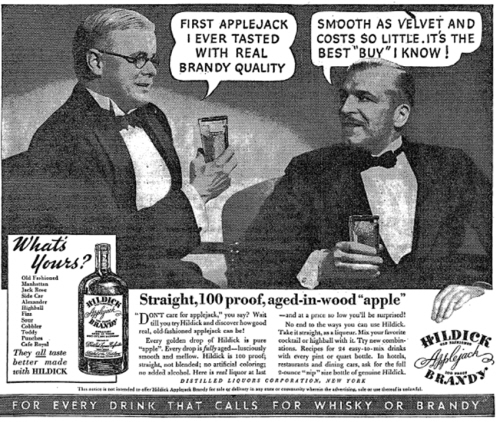
Entries Tagged as 'Applejack'

American Apple Brandy at Swig Well — Saturday, November 19

There are few compounds that are more sinful than the applejack of New Jersey. The name has a homely, innocent appearance, but in reality applejack is a particularly powerful and evil spirit. The man who intoxicates himself on bad whisky is sometimes moved to kill his wife and set his house on fire, but the victim of applejack is capable of blowing up a whole town with dynamite and of reciting original poetry to every surviving inhabitant.

– “A Wicked Beverage,” New York Times, April 10, 1894

You can learn a lot about a civilization by looking at what it drinks — and when that civilization is an early ancestor of your own, an exploration of the drinking habits can result in not only an interesting anecdote or two, but hopefully a better picture of who we are as a society.

In our early years, Americans drank pretty much anything that was available — but “available” is the operative term here. Our ancestors drank beer and wine, when it was available, which after the initial supplies ran out, wasn’t very often; soon, brandy and, more importantly, rum entered the picture, and eventually whiskey worked its way into the mix. But for much of America’s history, from the earliest Colonial days and for the more than two centuries that followed, Americans sated their thirst for beverages that conveyed a buzz mostly with libations that came from the fruit of the apple tree — primarily in the form of hard cider, which was EVERYWHERE and in tremendous quantities, but also in its harder, sharper and, at times, burly and boisterous relative: applejack, the distinctive American interpretation of apple brandy.

For a drink that so enamored our American ancestors (especially in the Northeast), we know awfully little about applejack and American apple brandy today. If your reading habits have brought you to this blog, you’re no doubt already familiar with Laird’s applejack and probably their bonded apple brandy, too, and you may even know of newer, small-scale producers somewhere (legal or, um, “artisanal”) who are making the stuff. But what else do you know about American apple brandy?

The answer, probably, is “not much.” A year or so ago, I was lamenting my own ignorance of a category that I still found pretty fascinating, so I started putting together bits of historical info that eventually made their way into my “As American as Apple Brandy” presentation at Tales of the Cocktail in July (where I was joined by another ardent fan of apple brandy, my good friend Misty Kalkofen, from Drink in Boston).

In case you missed my applejack schtick at Tales, there’s another opportunity coming up where you can see me get way too excited about this style of spirit that’s undergoing a bit of a comeback: on Saturday, November 19, I’ll be talking about American apple brandy as part of Swig Well: Seattle Drinking Academy, at Rob Roy.

Among the things I’ll babble about are bits of apple-brandy history such as:

  • In 1830, near the end of the farmstead epoch of American distilling, there were 430 distillers operating in New Jersey. Even after liquor production moved primarily to large, centralized distilleries, there were still approximately 60 distilleries in southern New York producing apple brandy in 1890, and in 1892, more than 70 distilleries in New Jersey produced around 13,000 barrels of the stuff.
  • Long ignored by the temperance movement, apple growers eventually came under Prohibitionist assault around the turn of the 20th century. The result? Thousands of apple trees were destroyed to disrupt the production of cider; facing this threat, apple growers embraced what became one of history’s most memorable marketing slogans: “An apple a day keeps the doctor away.
  • In anticipation of the demand that would follow Prohibition’s repeal, Laird’s & Co. announced in October, 1933, that they’d begun production of 1 million gallons of apple brandy—“for medicinal purposes.”
Oh — and there’ll be cocktails.

This is my first scheduled class at Swig Well, and while tickets are limited, I want to make sure every seat is full. The class is an hour-ish long (I get chatty sometimes), and takes place on the afternoon of Saturday, November 19 (I don’t have a set start time yet, but it’ll be between noon and 3pm) from 1:30pm to 2:30pm; tickets are $75 each.

Check out my original post about Swig Well, then head over to their site to see the syllabus and to sign up for tickets (you’ll need advance reservations — like I said, tickets are limited). And, while you’re at it, check them out on your social-media platform of choice: Swig Well on Twitter, and Swig Well on Facebook.

The PDT Cocktail Book

If last night’s Twitter traffic is any indication, I missed a hell of a party.

That’s to be expected. I’m home in Seattle, while the party in question — that for the release of Jim Meehan’s The PDT Cocktail Book – was, obviously, in New York, the way many of the parties I’m really envious of missing seem to be.

But the celebration was certainly justified. In addition to being one of the world’s more talented and influential barmen, and co-owner of one of the core bars in the craft-cocktail universe, Jim Meehan is now author of a cocktail guide that’s bound to be so definitive of a mixological moment and so influential for bartenders current and future that I can only agree with Gaz Regan (while conveniently stealing his words) that the PDT book is “the best book of its kind to hit the shelves in the twenty-first century. The very best. Bar none.” (Thanks for the help, Gary!)

Okay, details: there are more than 300 recipes in this book, all sourced from assorted manifestations of PDT’s menu. There are a few familiar classics of the Monkey Gland and French 75 variety, but where Meehan’s book not surprisingly shines is in its wealth of contemporary recipes, many from Meehan and his colleagues and associates, for drinks such as the hibiscus-and-tequila Green Harvest; Don Lee’s Rite of Spring, made with pickled ramp brine; and the apple brandy and beer-based Great Pumpkin.

I first tried the Great Pumpkin at PDT three years ago, and I brought a happy, hazy memory of this rich autumnal drink home with me. I got a chance to run a recipe for this drink in the San Francisco Chronicle about two years back, and now that the stores are once again flooded with pumpkin ale –something I have a hard time getting too enthusiastic about, except when it’s a component in mixed drinks such as this one — it’s a suitable time to take a look at the Great Pumpkin again.

Great Pumpkin
created by Jim Meehan, Fall 2008

  • 1 oz. Rittenhouse rye whiskey
  • 1 oz. Laird’s bonded apple brandy
  • 1/2 oz. grade B maple syrup
  • 1 whole egg, as fresh as possible
  • 2 oz. pumpkin ale*

Combine everything in a cocktail shaker and agitate to flatten the beer (it helps if you add the beer first, then splish it about to drive out all the bubbles so your shaker won’t pop open and spray booze and eggs all over the place). Shake well without ice to fully combine the ingredients, then add ice and shake like hell for 10 seconds. Strain into chilled fizz glass; top with grated nutmeg.

* Meehan recommends the pumpkin ale from Southampton; being in the PNW, I went with Elysian’s pumpkin ale, which worked pretty well.

The Great Pumpkin has a complexity of preparation that’s pretty much par for the course in the PDT Cocktail Book. While some of the book’s drinks call for bespoke ingredients — from simple preparations like house ginger beer or walnut-infused cognac, to more complicated items such as concord-grape shrubb, or tamarind puree — or for unusual ingredients that can take some work to track down, such as Boiron passion fruit puree or Abbott’s Bitters (though there are replicas now floating about), many of the drinks are relatively straightforward. Meehan frequently calls for particular brands of certain spirits or modifiers, which can be challenging if you intend to prepare that drink exactly according to the specifications, but if you exercise some flexibility with substitutes while keeping the drink’s final flavor in mind, a cocktail enthusiast with a reasonably well-stocked home bar should be able to tackle most of the book’s recipes.

And the drinks? Extraordinary. PDT has built a reputation as one of the world’s best bars not just because you have to go through a phone booth to get there and can get a hot dog with your Blood and Sand — the drinks developed by Meehan and his staff, which has included formidable talent such as Don Lee and John Deragon, are big in flavor, distinctive in character and reliably fantastic.

Here’s a very simple drink from Meehan that I mixed last weekend, and enjoyed very much: the Platanos en Mole Old Fashioned.

Platanos en Mole Old Fashioned

  • 2 oz. Zacapa 23 Centenario Rum*
  • 1/4 oz. Brizard Crème de Banane**
  • 12 drops Bittermens Xocolatl Mole Bitters

Combine ingredients in a mixing glass and fill with ice. Stir well until chilled, 20 seconds or so, and strain into a rocks glass with one large cube of ice. Garnish with a pinch of ground chili.

* Did I say be flexible? Zacapa works really well here, but if you absolutely have none in the house but you do have some Zaya lying around, it’ll get you there.
** More on flexibility—the only banana liqueur I have is Giffard Banane du Bresil, which ain’t too shabby and worked just great in this drink.

Anyway, I’m already running behind the release date on getting this post up, so I’ll can further chatter and leave it to you: grab a copy of The PDT Cocktail Book, and if you have particular luck with one or more of the recipes, let me know in the comments section.

60/30, #23-25: Three rounds with apple brandy

There’s something irrepressibly alluring about apple brandy. Cocktails made with Calvados or American apple brandy have been among my favorites ever since I first dabbled in the drinks world, and every autumn and early winter for the past five or so years, I’ve found myself besmitten with these drinks all over again.

Here are a few drinks with apple brandy that really hold their own.

A recent favorite in my rotation is the Royal Union, created by Boston bartender Carrie Cole from Craigie on Main. Carrie gave me this recipe a few months ago, while I was working on a feature on cocktail bitters for Imbibe (and thanks to Lauren Clark for pointing me in Carrie’s direction). We wound up not running the drink recipe in the magazine — a couple of the ingredients may take a little searching to find, though they’re by no means rare or obscure — but Carrie gave me permission to put it here on the blog instead, where my dozen or so remaining readers can check it out for themselves.

The Royal Union has a few things that make it my kind of ideal drink for this time of year: first, obviously, it’s made with Calvados; second, it has not one, or two, but THREE kinds of bitter liqueurs in the mix; and third, it’s dosed with Bittermens Xocolatl Mole bitters (which was the reason I’d approached Carrie for a bitters article). Details—

The Royal Union
created by Carrie Cole, Craigie on Main, Boston

  • 1 ounce Calvados
  • 1 ounce Averna
  • 1/2 ounce Nux Alpina
  • 1/2 ounce Amaro Nonino
  • 2 dashes Bittermens Xocolatl Mole bitters

Stir well with ice until chilled, about 30 seconds. Strain into chilled old-fashioned glass – no ice, no garnish.

Even with three kinds of amari, the Royal Union is still very gentle. Amaro Nonino tastes to me like souped-up rosso vermouth, and Averna is rich and chocolatey, with a note I always think of as “cola” but whenever I bring that up to other people I get a blank stare in return. Nux Alpina brings this drink together — a walnut liqueur from Haus Alpenz, this pitch-black stuff has the back-palate bitterness of young walnuts, but a rich complexity that softens the finish, and the bitters add a little cinnamon zing to keep the dark, ponderous flavors in the glass from getting too serious about the whole thing.

A few years ago, while working on an applejack story for Imbibe, I was introduced to another Boston bartender who had an affinity for apple booze: Misty Kalkofen. Now at Drink, Misty is one of my absolute favorite people in the industry, and someone with whom I don’t get nearly enough opportunities to work.

At the time Misty was working at Green Street, and she’d come up with a rich, hearty drink that was perfect for cooler months, sweetened with maple syrup and given a French monastic touch with a dollop of Benedictine. At the time I wrote the piece, Misty and I were talking about applejack; nowadays I’m much more likely to use the Laird’s Bonded Apple Brandy in pretty much any drink calling for the American style of the spirit, and to my taste it works just dandy in this drink.

Fort Washington Flip
created by Misty Kalkofen, currently at Drink, Boston

  • 1 1/2 ounces apple brandy
  • 3/4 ounce Benedictine
  • 1/2 ounce maple syrup (go for Grade B)
  • 1 whole egg, as fresh as you can possibly manage
  • – nutmeg, for garnish

Combine everything in a cocktail shaker and shake really hard, without ice, for at least 10 seconds, until the egg is pretty well mixed with the other ingredients. Add ice and shake again for at least 10 seconds; strain into chilled cocktail glass, and hit it with a few scrapes of nutmeg.

Another apple-brandy drink spent years on my “to try” list, but for whatever reason I’d never gotten around to mixing it: the Pan American Clipper. Unlike so many of the other drinks he wrote about in The Gentleman’s Companion from 1939, Charles H. Baker, Jr. shed little light on the Pan American Clipper, simply saying it’s “From the Notebook of One of Our Pilot Friends Who—when Off Duty—May Seek One.”

There’s a reason this drink took so long to cross the divide between recipe notebook and cocktail shaker: on paper it simply doesn’t sound that exciting. Basically just a Jack Rose with a single dash of absinthe, the Pan American Clipper seemed to offer little that was new or genuinely exciting; for years I looked at the recipe and thought, “I like the Jack Rose, and I like absinthe, but I don’t really feel compelled to mix this right now.”

Recently, though, I began a studious exploration of Baker’s books (or as studious as one can be while sampling through a cocktail book — hey, everyone’s gotta have a hobby), and the Pan American Clipper came up again. “Fine,” I thought. “A Jack Rose with an attitude, it is.” I twisted the knobs a little bit — Baker’s proportions are almost always kinda hinky, so I aimed for a little better balance — but otherwise the recipe is his.

Pan American Clipper
Adapted from The Gentleman’s Companion, by Charles H. Baker, Jr., 1939

  • 1 1/2 ounces applejack (Baker recommends Calvados; I went with Laird’s bonded)
  • 3/4 ounce fresh lime juice
  • 1/4 ounce homemade grenadine (to taste, depending on sweetness)
  • 1 dash absinthe

Shake well with ice, strain into chilled cocktail glass. Proceed.

What I’d forgotten was how effectively absinthe can change everything. The snappy, fruity tartness of a Jack Rose is still there, but the absinthe tinkers with every aspect of the flavor equation. First there’s the aromatic tangle of absinthe’s ethereal herbaceousness, and then the fat vivaciousness of anise is the first flavor to arrive, coming in just before the citrus can poke its acidic elbow into your palate. Then, on the finish, that anise richness and herbaceous flourish is back, riding out on the sweet fruitiness of the pomegranate syrup.

All in all, the Pan American Clipper is still simply a Jack Rose with a slightly different haircut. It’ll never be among my favorites, but it’s still pretty goddamn good.

Bitter Maestro

It’s been a long, busy summer of mostly ignoring this blog, and if left to my own devices I’d likely let the radio silence continue until well after Labor Day. But in response to several inquiries and gentle nudges following the last round of Mixology Monday — a theoretically monthly event that last took place in May — I once again donned my blogging beanie and found a host (or nine) for upcoming events, the first of which is today (at least it’s still today for another half hour or so).

When I put out the call for hosts via Twitter (I’m @cocktailchron, in case you’re wondering), I wasn’t surprised that the first offer came from Lindsey Johnson, who in her day job — if that’s the right term for it — works with the spirits industry as the maven behind Lush Life Productions, and who keeps her social media street cred by not only being a tireless Tweeter (sorry — usually I avoid such new-media lingo, but my amour for alliteration won out) and by participating in social-media focused panel discussions such as the one she joined me on last month at Tales of the Cocktail, but by also publishing the blog, Brown, Bitter and Stirred — which, as luck would have it, is the theme for this month’s MxMo.

While it’s still August, autumn seems to be creeping in early here in the Pacific Northwest, and dark, boozy drinks laced with a little elaborate Italian liqueur are perfectly suited to the next 10 months of mostly unbroken gray. Here’s a drink I was introduced to last fall that I wrote up for the San Francisco Chronicle earlier this year: the Bitter Maestro.

The Bitter Maestro is from Brooke Arthur, who was then at Range and now helms the bar at Prospect in San Francisco. I swung by Range last October on the night before Whiskyfest, to say hi to Brooke and to spend a little time at Range’s small, comfortable bar. With practically no direction from me, Brooke brought over the three things I needed most at 9 o’clock on a Thursday evening: salad, ice cream and a cocktail built on a base of cask-strength whiskey.

Brooke said that the Bitter Maestro was related to a drink from John Deragon at PDT, and while the stump-blaster she poured me had a base of 140-plus-proof Thomas Handy Rye, it also works well with something of a more modest (though still mighty) octane, such as Rittenhouse bonded or Russell’s Reserve Rye. Playing off this spicy base is a small pour of applejack (though Laird’s bonded apple brandy works well, especially if you have a higher-proof rye in the mix), with a little mellowing from Dubonnet rouge and the bitter angle provided by a half-ounce of Amaro Nonino.

In the realm of bitter liqueurs, Nonino is a bit of a pussycat along the lines of Averna, as compared to the rough-trade bitterness found in stuff like Unicum or Fernet Branca, and Nonino’s gentle nip of bitter is a nice counterpoint to the roar of the rye. For a change of pace and to bump up the bitterness a tad, I’ve tried the Maestro with Bonal Gentiane-Quina substituted for the Dubonnet; it dries out the drink a little more (though it doesn’t need it), and gives it a little more back-palate action for those times when the mood takes you there.

Anyway, thanks to Brooke for introducing me to this drink and for sharing the recipe.

Bitter Maestro

  • 1 1/2 ounces rye whiskey (go for higher proof)
  • 1/2 ounce applejack or apple brandy
  • 1/2 ounce Dubonnet rouge
  • 1/2 ounce Amaro Nonino
  • 1 dash pomegranate concentrate or grenadine

Combine in a mixing glass and fill with ice; stir well and strain into chilled cocktail glass. Twist a bit o’ lemon peel over the drink and discard, and garnish with a few pomegranate seeds.

Want to see what everyone else has been up to for Mixology Monday? Head over to Lindsey’s place and check out the submissions.

30/30, #11: the Diamondback

In the late fall and early winter, I fell into a swoon regarding the perfect marriage between two ingredients: rye whiskey and apple brandy. While I’d flirted with this combination before, I’d never really explored its potential. By November, though, I was reaching for the black-labeled bottles of Rittenhouse bonded rye and Laird’s bonded apple brandy on most nights, trying different liqueurs and other flavoring agents to take the drinks in different directions. While there were a couple of loser drinks in the trials, most came through incredibly well. Here’s the drink that first sparked my interest in this flavor combination, a cocktail that I tried several years ago and have kept coming back to on a regular basis: the Diamondback.

The first appearance I know of for this drink is in Ted Saucier’s Bottoms Up, from 1951, and Saucier describes it as composed of two parts Old Schenley rye whiskey, with one part each of applejack and yellow Chartreuse. I initially came across this drink on Chuck Taggart’s blog way back in 2005, when my blog was in its infancy, and the comment I posted for the drink was, I think, my first exchange with Chuck. The recipe he posted (using the more potent green Chartreuse in place of the yellow) had likewise been suggested in a blog comment by Murray Stenson, who had posted the Diamondback on Zig Zag‘s bar menu. After reading Chuck’s post I became an occasional fan of the Diamondback, and even included it in an Imbibe story on applejack a couple years back.

I mention this connection because I’m coming off a busy weekend, one that was filled with eating and drinking with Chuck and Wes (and a whole slew of Seattle cocktail people) during their long-overdue visit to Seattle. Murray even dropped by during last night’s cocktail party at Dayne & Wendy’s, and at some point Keith Waldbauer mixed up a Diamondback. This may seem a trivial personal detail to many, but the way I’ve come to know people like Chuck and Murray over the almost four years since I first came across this recipe made covering this drink appropriate, in a sentimental kinda way. Don’t care for the sentimentality? Mix one anyway — with the alcoholic firepower supplied by three ingredients in the 100-proof and up range, the Diamondback will put you in a reflective state of mind pretty fast.

Diamondback

  • 1 1/2 ounces rye whiskey (Rittenhouse bonded strongly recommended)
  • 3/4 ounce applejack (Laird’s bonded apple brandy strongly recommended)
  • 3/4 ounce Chartreuse (yellow works, but green works better)*

Stir well with ice and strain into chilled cocktail glass. Garnish with a cherry if that’s your thing.

* As Dietsch noted when he wrote up this drink for Mixology Monday, this amount of Chartreuse can push the drink over to the sweet side; you may wish to dial it back to a half-ounce or so and see how that suits your tastes.

This drink is part of 30/30, a series of 30 drinks in 30 days — or as much as I can keep up before collapsing in a weary, booze-addled heap.

  • Liquor.com - Your expert guide to all things cocktails and spirits.
  • Archives

  • Subscribe via e-mail

    Enter your Email


    Preview | Powered by FeedBlitz
  • Categories

  • Support