
Entries Tagged as 'Calvados'

60/30, #23-25: Three rounds with apple brandy

There’s something irrepressibly alluring about apple brandy. Cocktails made with Calvados or American apple brandy have been among my favorites ever since I first dabbled in the drinks world, and every autumn and early winter for the past five or so years, I’ve found myself besmitten with these drinks all over again.

Here are a few drinks with apple brandy that really hold their own.
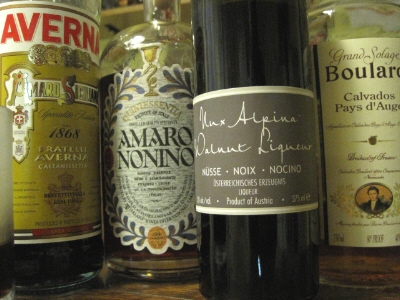
A recent favorite in my rotation is the Royal Union, created by Boston bartender Carrie Cole from Craigie on Main. Carrie gave me this recipe a few months ago, while I was working on a feature on cocktail bitters for Imbibe (and thanks to Lauren Clark for pointing me in Carrie’s direction). We wound up not running the drink recipe in the magazine — a couple of the ingredients may take a little searching to find, though they’re by no means rare or obscure — but Carrie gave me permission to put it here on the blog instead, where my dozen or so remaining readers can check it out for themselves.

The Royal Union has a few things that make it my kind of ideal drink for this time of year: first, obviously, it’s made with Calvados; second, it has not one, or two, but THREE kinds of bitter liqueurs in the mix; and third, it’s dosed with Bittermens Xocolatl Mole bitters (which was the reason I’d approached Carrie for a bitters article). Details—

The Royal Union
created by Carrie Cole, Craigie on Main, Boston

  • 1 ounce Calvados
  • 1 ounce Averna
  • 1/2 ounce Nux Alpina
  • 1/2 ounce Amaro Nonino
  • 2 dashes Bittermens Xocolatl Mole bitters

Stir well with ice until chilled, about 30 seconds. Strain into chilled old-fashioned glass – no ice, no garnish.

Even with three kinds of amari, the Royal Union is still very gentle. Amaro Nonino tastes to me like souped-up rosso vermouth, and Averna is rich and chocolatey, with a note I always think of as “cola” but whenever I bring that up to other people I get a blank stare in return. Nux Alpina brings this drink together — a walnut liqueur from Haus Alpenz, this pitch-black stuff has the back-palate bitterness of young walnuts, but a rich complexity that softens the finish, and the bitters add a little cinnamon zing to keep the dark, ponderous flavors in the glass from getting too serious about the whole thing.

A few years ago, while working on an applejack story for Imbibe, I was introduced to another Boston bartender who had an affinity for apple booze: Misty Kalkofen. Now at Drink, Misty is one of my absolute favorite people in the industry, and someone with whom I don’t get nearly enough opportunities to work.

At the time Misty was working at Green Street, and she’d come up with a rich, hearty drink that was perfect for cooler months, sweetened with maple syrup and given a French monastic touch with a dollop of Benedictine. At the time I wrote the piece, Misty and I were talking about applejack; nowadays I’m much more likely to use the Laird’s Bonded Apple Brandy in pretty much any drink calling for the American style of the spirit, and to my taste it works just dandy in this drink.

Fort Washington Flip
created by Misty Kalkofen, currently at Drink, Boston

  • 1 1/2 ounces apple brandy
  • 3/4 ounce Benedictine
  • 1/2 ounce maple syrup (go for Grade B)
  • 1 whole egg, as fresh as you can possibly manage
  • – nutmeg, for garnish

Combine everything in a cocktail shaker and shake really hard, without ice, for at least 10 seconds, until the egg is pretty well mixed with the other ingredients. Add ice and shake again for at least 10 seconds; strain into chilled cocktail glass, and hit it with a few scrapes of nutmeg.

Another apple-brandy drink spent years on my “to try” list, but for whatever reason I’d never gotten around to mixing it: the Pan American Clipper. Unlike so many of the other drinks he wrote about in The Gentleman’s Companion from 1939, Charles H. Baker, Jr. shed little light on the Pan American Clipper, simply saying it’s “From the Notebook of One of Our Pilot Friends Who—when Off Duty—May Seek One.”

There’s a reason this drink took so long to cross the divide between recipe notebook and cocktail shaker: on paper it simply doesn’t sound that exciting. Basically just a Jack Rose with a single dash of absinthe, the Pan American Clipper seemed to offer little that was new or genuinely exciting; for years I looked at the recipe and thought, “I like the Jack Rose, and I like absinthe, but I don’t really feel compelled to mix this right now.”

Recently, though, I began a studious exploration of Baker’s books (or as studious as one can be while sampling through a cocktail book — hey, everyone’s gotta have a hobby), and the Pan American Clipper came up again. “Fine,” I thought. “A Jack Rose with an attitude, it is.” I twisted the knobs a little bit — Baker’s proportions are almost always kinda hinky, so I aimed for a little better balance — but otherwise the recipe is his.

Pan American Clipper
Adapted from The Gentleman’s Companion, by Charles H. Baker, Jr., 1939

  • 1 1/2 ounces applejack (Baker recommends Calvados; I went with Laird’s bonded)
  • 3/4 ounce fresh lime juice
  • 1/4 ounce homemade grenadine (to taste, depending on sweetness)
  • 1 dash absinthe

Shake well with ice, strain into chilled cocktail glass. Proceed.

What I’d forgotten was how effectively absinthe can change everything. The snappy, fruity tartness of a Jack Rose is still there, but the absinthe tinkers with every aspect of the flavor equation. First there’s the aromatic tangle of absinthe’s ethereal herbaceousness, and then the fat vivaciousness of anise is the first flavor to arrive, coming in just before the citrus can poke its acidic elbow into your palate. Then, on the finish, that anise richness and herbaceous flourish is back, riding out on the sweet fruitiness of the pomegranate syrup.

All in all, the Pan American Clipper is still simply a Jack Rose with a slightly different haircut. It’ll never be among my favorites, but it’s still pretty goddamn good.

30/30, #5: Corpse Reviver #1, and then some

It’s been a while since I’ve fully visited the range of drinks that were variously known as corpse revivers, fog cutters, gloom chasers and what have you — regardless of the moniker, the drinks that were designed to be consumed at a relatively early hour to dispel the effects of a long night before.

Thanks to Ted Haigh — who propelled the Corpse Reviver #2 out of obscurity and into ubiquity (at least at craft-cocktail establishments) when he included it in Vintage Spirits and Forgotten Cocktails, now poised to retake the bibulous world in an expanded edition — the corpse reviver category has (sorry) returned from the dead. Somewhat, that is.

For there to be a #2, there has to be a #1 — but as with many freshman efforts, the initial entry into the category (at least, the one that was dubbed #1 in 1930s bar manuals by Harry Craddock and Patrick Duffy) has been overshadowed by its more illustrious successor. In the case of the Corpse Reviver, this is as it should be — while version #1 is certainly nothing to sneeze at, it lacks the delicacy of the #2; plus, if the directions are followed to the letter, it’s an ass-kicker. Let’s take a quick look –

Corpse Reviver #1

  • 1 1/2 ounces brandy
  • 3/4 ounce apple brandy
  • 3/4 ounce sweet vermouth

Stir well with ice, strain into chilled cocktail glass. Hit it with a lemon peel, if you like.

Short, sharp and strong — not bad, but nothing that remarkable. No wonder it faded.

But, a year or so back, I was served a variation on this drink by Jamie Boudreau. Jamie freshened up the CR1 by using pommeau de normandie in place of the apple brandy; this reduced the alcohol level of the cocktail, making it a bit more managable, while also bumping up the fruitiness factor without adding extra sweetness. Rounded off with peach bitters and Angostura, and the Corpse Reviver #1 had a — sorry again — new lease on life. Here’s Jamie’s version, the Naramata:

Naramata

  • 1 1/2 ounces cognac
  • 1 oz sweet vermouth (Cinzano recommended)
  • 3/4 ounce pommeau de normandie
  • 2 dashes peach bitters
  • 2 dashes Angostura bitters

Stir well with ice, strain into chilled cocktail glass. Flame an orange twist over the drink and use as garnish.

I tried a few versions of this drink; while the impulse is always there to reach for a premium vermouth like Carpano Antica, it most assuredly does not work in this cocktail. The Antica has such a strong flavor that it overwhelms the pommeau; instead I used Martini & Rossi as it’s my workhorse sweet vermouth, and it seemed to work well in this drink. Also, I eschewed the cognac recommendation and instead went with Armagnac, reasoning that the more rugged, earthy flavor could lend an interesting angle to the drink. I doubt I could tell a Naramata made with cognac from one made with armagnac in a blind tasting, but the Armagnac did its job well and I have no complaints.

Anyway, this is another drink I’ve been thinking about for a long while, dusted off for the new millenia.

This drink is part of 30/30, a series of 30 drinks in 30 days — or as much as I can keep up before collapsing in a weary, booze-addled heap.

MxMo New Orleans: Oh, the choices you’ll face…

I’d like to write about all the great drinks I enjoyed in New Orleans, but to be honest, after the first couple of Sazeracs everything started running together until, a week later, I boarded the flight home, still bleary eyed and happy and reeking only slightly of absinthe. God, I love New Orleans.

Before Tales of the Cocktail, I had the bright idea of hosting the Mixology Monday on the Monday following the event; then, it’d be easy enough to just slap together all the posts on drinks that bloggers were putting up at Tales Blog during the event, along with those from folks who couldn’t make it, and we’d all be done by the time the Tales hangover wore off.

Of course, I wasn’t counting on the royally uncooperative wi-fi at the Monteleone, and the sheer volume of events and distractions that kept me and a good majority of the other bloggers away from our computers until we were safely back at home. Somewhere around Thursday I realized that it was better to be out drinking and eating and talking and schmoozing than to be tapping at my keyboard, and while those of you who couldn’t come to New Orleans had to contend with a lull in posts, I can say with a good deal of certainty that I’m the better off for it.

Here’s proof. Before heading to New Orleans, I checked in with Chris Hannah at Arnaud’s French 75 bar to see when he’d be working. Chris has earned a reputation as one of the top bartenders in the city, and I couldn’t miss the chance to visit the French 75 — easily one of the most beautiful and historic bars in a city filled with them — while Chris was on duty. I dragged a contingent of booze geeks to the bar on Tuesday, the first night in town for most of us, but we just missed Chris (though we did have some great drinks in the beautiful bar). On Friday I had better luck, and fortunately had the mind to put my choice of drink in his hands. Here’s what he came back with:

Bywater, an original drink by Chris Hannah, Arnaud’s French 75 Bar, New Orleans

  • 1 3/4 ounces Cruzan 5-year-old rum (Chris suggests the Cruzan Single Barrel as a suitable replacement)
  • 3/4 ounce Amer Boudreau (housemade Amer Picon replica, using Jamie Boudreau’s recipe)
  • 1/2 ounce Chartreuse (yellow, I’m assuming)
  • 1/2 ounce Falernum (housemade, I’m guessing, using the recipe that ran in Imbibe last summer)

Stir with ice & strain into chilled cocktail glass.

The bar was humming during my visit, so I didn’t get much of a chance to chat with Chris, but he kindly provided this recipe. I’m assuming he used yellow Chartreuse, as the green has the habit of walloping both the drinker and the flavor of the cocktail, whereas the Bywater has a nice balance; and a housemade falernum made with fresh lime juice. I tried one of these at home using the Falernum #10 that I poured during the “Make Your Own Cocktail Ingredients” session; this version doesn’t call for fresh lime juice, and I found the drink needed just a little splash of acid to keep the sweetness in check. Though really, that’s kind of the beauty of this kind of drink, that uses not just one but two homemade ingredients: to position the flavors of the cocktail just so, you have the opportunity to not only adjust the levels of each ingredient, but to tinker with the flavors of the ingredients themselves to custom-craft a good drink, as Chris masterfully did with the Bywater.

The drink takes two divergent but not dischordant courses: first, you have a very gentle, vanilla-ey rum paired with the island-punch sweetener falernum; but then, you introduce two very complex and very resonant French (or French-style) ingredients, that introduce high bitter-orange notes and a mid-range light bitterness, with the elaborate floral and herbal characteristics of the Chartreuse.

The cocktail is named, of course, for the Bywater neighborhood in New Orleans, part of the Ninth Ward. I figured plenty of folks would be coming to this month’s MxMo armed with Ramos fizzes and Sazeracs, and I wanted to have a fantastic contemporary cocktail with strong New Orleans roots. The Bywater certainly fits the bill.

And since many of this month’s participants seem to be taking the Tales-style two-fisted approach with their entries, I should follow suit with the cocktail Chris poured me after I polished off my Bywater. This time, rather than try to explain it in a crowded, noisy bar, Chris simply handed me a copy of the Food & Wine Cocktails 2008 book, which includes this original recipe:

Accoutrement

  • 2 ounces Calvados
  • 3/4 ounce Strega
  • 1/2 ounce Creole Shrubb
  • 3/4 ounce fresh lemon juice
  • 2 dashes Peychaud’s bitters

Shake well with ice and strain into chilled cocktail glass; garnish with brandied cherries.

Between the Calvados and the Creole Shrubb, I was hooked. Calvados makes some incredibly complex and evocative cocktails, and the gentle spice of the Shrub and the Strega really make this an elegant drink.

I’ve had plenty of lackluster cocktails in New Orleans at previous Tales of the Cocktail; this year, the general level of quality was notably improved, but when I positioned myself at Chris Hannah’s bar and let him show me what he had, I was absolutely blown away. I know where I’m drinking next year.

I’ve lost count on how many bloggers have joined in this Mixology Monday; I know it’s huge, though, so keep an eye out for the roundup in the next couple of days.

Farmer’s Bishop

Last Christmas — and the one before that, too, as a matter of fact — I was all about getting into the festive holiday spirit by torching up big bowls of punch. I’m not sure if I’ll get to that this year: I have some aged eggnog that should be ready Christmas Eve, and if that doesn’t put me in the hospital then I’ve kind of been jonesing for Reveillon Cocktails and Tom & Jerry on Christmas Day and at other festive events (I even started on the Reveillons early, as should you, after reading Chuck’s recent post revisiting his extraordinary contribution to holiday mixology). But should things change, I plan to have some oranges, cloves and cider handy, along with a box of matches. And maybe this year I’ll try to lay in some extra apple brandy, just in case.

Farmer's BishopHere’s a little novelty I found in an old Peter Pauper Press holiday drink guide I recently picked up on eBay: the Farmer’s Bishop (I’m sure it’s out there in other books, I just haven’t gone looking yet). It’s related to the Christmas Rum Punch (aka English Bishop) I wrote about last year, with the only difference between the two being the use of apple brandy instead of rum. I have no gripe with the rum version — damn tasty, that — but I’m really intrigued by how this could turn out. I’d imagine you’d want something like Laird’s bonded apple brandy, or possibly something from Laird’s line of aged brandies or a Calvados or even Clear Creek’s young apple brandy, instead of the Laird’s applejack, which won’t provide as much of a fruit flavor as this punch might require. If anybody goes for it, please post a note in the comments section.

Farmer’s Bishop adapted from The Holiday Drink Book, Peter Pauper Press, 1951

  • 6 oranges
  • around 4 dozen whole cloves
  • 1 bottle apple brandy
  • 2 tablespoons sugar
  • 1/2 gallon cider
  • 1 teaspoon ground cinnamon
  • 1/4 teaspoon ground cloves
  • 1/4 teaspoon ground nutmeg
  • and if you have any pimento dram kicking around, an ounce or so would work wonders here

Stick each orange with 8 cloves, and bake them whole in a slow oven (300F, I’m guessing) for 1 hour. Place them in a heated punch bowl and prick them well with a fork. Heat the apple brandy in a saucepan until warm — CAREFUL, especially if you’re using a gas stove — and pour over the oranges; sprinkle with the sugar. While warming the brandy, heat the cider to almost boiling. Take 1/2 cup of the cider and mix the remaining spices in it, then set it aside. Carefully light the brandy — I like to use a sugar cube soaked with a bit of the brandy, place it in the bowl of a long-handled spoon, light it and then stand back while placing the burning cube in the boozy punch. Let it burn for a few seconds, then add the hot cider to extinguish the flames; stir in the cup of spiced cider. You can keep it warm in a chafing dish or on the stove (I’d imagine a crockpot would work, if somewhat lacking in pizzazz). Serves 24.

Farmer's Bishop

The Avenue

I’m still trying to wrap my head around this one. The recipe is from Ted Haigh’s Vintage Spirits & Forgotten Cocktails (Haigh credits the Cafe Royal Bar Book from 1937), and I’ve been meaning to try it for months, but lacked one essential component: passion fruit juice (not nectar, or syrup — juice).

Not that I’ve tried too hard to find it. Typically, when I’m in a store likely to carry it, I’m searching for something else with a singular focus, and thus walk right past it. But today, with a little time on my hands and a firm resolve to track down this unusual ingredient, I started poking around Pike Place Market and, at Pike Place Grocery, I finally found what I was seeking.

From the recipe, the Avenue looks intriguing: Bourbon, Calvados & passion fruit juice, with a little grenadine and, for mystery and exoticism, orange flower water. What’s not to like? In the glass, though, the drink seems to be searching for an identity. The OFW is right there at the front, with it’s distinctive perfume, and again at the end, with its lingering aftertaste. In between, the Calvados and the passion fruit juice seem to be searching for some sort of fruity foundation, but no clear note is evident, and the bourbon is almost totally hidden in the drink.

While the flavor profile seems slightly confused, I’m wondering if that uncertain, ethereal character is part of the drink’s charm — instead of a firmly rooted flavor, such as that in a Manhattan or a martini or most other drinks, the Avenue has little ghostly touches of taste that flit across the palate and then disappear. While drinking it, I try to pin down the flavor in my mind, only to have it slip away like a puff of smoke in a gust of wind.

Fortunately, for a drink that’s so hard to understand at first blush, the Avenue is truly delicious. I made the cocktail with Chateau du Breuil Calvados and the soft, wheated Weller 12-year-old bourbon, a favorite of mine, so it was nice and comfortable to wrestle with. I’d say the Avenue is “interesting,” though that tag is typically the kiss of death for new drinks and flavors; if something is “interesting,” you try it once. Unlike the other “interesting” cocktails, though, the Avenue is worth further exploration.

The Avenue Cocktail

  • 1 ounce calvados
  • 1 ounce bourbon
  • 1 ounce passion fruit juice (you could also try it with nectar)
  • 1 dash grenadine
  • 1 dash orange flower water

Shake with ice and strain into a chilled cocktail glass.

  • Liquor.com - Your expert guide to all things cocktails and spirits.
  • Archives

  • Subscribe via e-mail

    Enter your Email


    Preview | Powered by FeedBlitz
  • Categories

  • Support