Entries Tagged as 'Brandy'

Kay Francis Cocktail

“A Time-Tested Favorite from Venezuela”

So wrote Charles H. Baker, traveler, raconteur, and possibly the ultimate fan of exotic tippling.

Yesterday I posted the details from an e-mail exchange I recently had with New York bartender and writer St. John Frizell over at Blogging Tales of the Cocktail. That exchange came at a time when I’ve been in a bit of a lull between drink explorations. These periods are always kind of troubling for me: nothing sounds all that exciting, and even the old palate refreshers seem to have lost their allure.

As I’ve mentioned before, though, when these periods of libational ennui set in, one of the best cures I’ve found is a little time with the books of Mr. Baker. His drinks can be interesting variations on tried-and-trues, and sometimes they can be just plain odd, but on occasion you come across a recipe that has to be tried to be believed. I’ve had disappointments before, but with this most recent expedition in which I turned up the “Maracaibo Kay Francis Cocktail,” I was fortunate to come across something pretty pleasant.

Anis del MonoBaker credits Señor F. Garcia Bode, “Master- of-Mahogany-&-Mix at Cafe Plaza, at West Boliver 13,” with creation of this drink. It is, at first glance, an odd one: Spanish brandy and Spanish anisette in equal parts, with another part of strong black tea. But, it’s one of those odd combinations that may just work, the tannins in the tea taking the sweet edge off the anisette, and the sharp anise note breathing some life into the brandy. I tried this with cognac in place of Fundador, based on the contents of my liquor cabinet, but I’m fortunate to have a bottle of Anis del Mono on hand; it has a bright crispness that I like in an anisette, plus it’s relatively cheap, so if you come across a bottle I recommend you lay in a supply. For tea, I just used a bag of PG Tips — I’m more of a coffee guy, and it was the only black tea I could find in the kitchen cabinet — and while it certainly did the trick, I may swing by the tea shop later to pick up something a little more adventurous.

Anyway, this is a rut-buster for sure. As Baker wrote, “Try this one when some well-traveled soul drops-in, to vary the old usual Cocktail routine.” Sound advice indeed.

Kay Francis Cocktail

  • 1 oz Fundador brandy [or cognac]
  • 1 oz Anis del Mono [or other decent anisette]
  • 1 oz strong black tea

Shake with ice and strain into chilled cocktail glass. Twist lemon or orange peel on top, then discard peel.

MxMoXXVI: Keep the Nose Up

Mixology MondayTwo years.

I hadn’t pointed it out earlier — thanks to all the other things I’ve been wrangling with lately, I kind of forgot — but this month marks the second anniversary of the launch of Mixology Monday (this month hosted by the wonderful Anna at Morsels & Musings). I’ll save the misty sentimentality for another post, but for now, let’s just mark the occasion by noting that bloggers keep coming to these things — more than ever, at last glance — and we’ve somehow managed to keep this little drink-blogging celebration in the air for two years without it plummeting to the ground.

Look out below!If only the same could have been said for the de Havilland Comet.

With a rush of hoopla and hubris that, in hindsight, harks back to that surrounding the Titanic, the Comet — the world’s first commercial passenger jetliner — entered service in 1952, making its maiden BOAC commercial flight from London to Johannesburg in May of that year. It sharply cut flight times, was a model of passenger comfort that can only be dreamed of in today’s era of nonexistent legroom and cattle-car conditions, and was so popular that the Queen Mother was an early passenger, becoming the first member of the British royal family to fly in a jet aircraft.

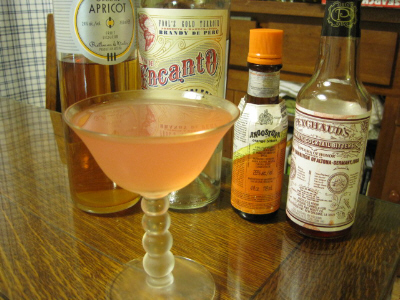
Van der HumCelebrating this launch — according to David Wondrich’s Killer Cocktails — was this sidecar relation, put together by Eddie “King Cocktail” Clarke at the Albany Club in London, and featuring the South African tangerine-and-herb liqueur, Van der Hum. Tart and fruity, these Comets go down fast.

Just like the winged ones did. Less than a year after commencing service, Comets started dropping out of the sky — metal fatigue, it turned out, a problem remedied in later models (and avoided by competing aircraft manufacturers), but by then the damage was done: the Comet’s reputation had taken a hit, and sales never completely recovered.

Fortunately, this Comet is still around:

Comet (adapted from Killer Cocktails, by David Wondrich)

  • 2 ounces cognac
  • 1 ounce yellow grapefruit juice (good luck finding yellow — I had to settle for pink)
  • 1/2 ounce Van der Hum
  • 1 dash Angostura bitters

Shake well with ice and strain into chilled cocktail glass.

Thanks for two years of Mixology Mondays, everyone; now head on over to Anna’s place to see what everyone else has been up to.

MxMo XXIII: Brrrrrr…..

It’s snowing.

That may not sound like a big deal to those of you in places that actually have winter, but here in Seattle, it doesn’t happen all that often. This winter, however, we’ve seen snow more than usual (including, memorably, on Christmas Day), though it’s usually just a wet, sloppy half-inch that covers parked cars and fence posts for a couple of hours while making the standard Northwest winter puddles all the colder and drearier.

As is the case tonight. Thank god there’s brandy.

Wait – let me amend that: thank god there’s brandy, port, David Wondrich’s latest book and Mixology Monday to take the chill off. Foreseeing the kind of frigid misery many of this month’s participants would no doubt be enduring, our kind host Marleigh – who, it should be noted, lives in sunny Southern California – proposed “Brandy” as the theme for this round. Since tomorrow it’s supposed to hit 70 degrees in Los Angeles, I hope Marleigh is getting quite a giggle as the rest of us shiver our way through tonight’s post.

I’ve long been a fan of the Sensation, which appeared in David Wondrich’s Esquire Drinks (now out of print; thankfully, the Esquire Drinks Database has recently rejoined the living). With its base of port backed up with half as much brandy, and a dash of orange juice for brightness, the Sensation is a gentle, soothing companion for the dead of winter.

Wondrich revisited the drink (or its ancestor, anyway) in IMBIBE!, this time running it as the St. Charles Punch, named after a fine old New Orleans hotel. This version lost the OJ but introduced the juice of 1/4 of a lemon, along with enough sugar to take the edge off. (It was also served over shaved ice with fruits in season, whereas the Sensation was served straight up, but I’m not going to dwell on that right now.)

This is still a lovely drink, but sometimes you need something capable of warming you to your rafters, even if it’s served ice-cold. That’s when it pays to start digging into the explanatory text that follows each recipe in IMBIBE! (Seriously, that’s where I’m finding some of the best stuff: need proof? Take his suggestion to top the Morning Glory with Champagne. Jesus.)

EnchantressIn this case, Wondrich idly tosses out the Enchantress, which he informs us appeared in American Barkeeper in 1867. A modest change in recipe, but a very pleasing one: the brandy is doubled, but the soft lusciousness of the port keeps it from getting out of line, and some curacao in place of the sugar adds a little flourish around the edges (you may wish to dial back the ingredients accordingly, so your drink actually fits into a sensible-size glass). Served up in a wine goblet (or champagne flute, as Wondrich suggests — though it’s absolutely fine in a cocktail glass, as my photo should attest), the Enchantress isn’t disheartened by a wintry night outside. If only I could say the same for myself.

Enchantress, adapted from IMBIBE!, by David Wondrich

  • 1 1/2 ounces ruby port
  • 1 1/2 ounces cognac
  • Juice of 1/4 lemon (about 1/2 ounce)
  • 1 1/2 teaspoons orange curacao (to taste, based on the lemon juice)

Shake well with ice and strain into a chilled wine goblet or champagne flute.

And, since I mention them, here are:

Sensation (alias Brandied Port), adapted from Esquire Drinks

  • 2 ounces ruby port
  • 1 ounce brandy
  • Dash fresh-squeezed orange juice (optional)

Shake well with ice and strain into chilled cocktail glass; garnish with twist of lemon or orange peel.

St. Charles Punch, adapted from IMBIBE!

  • 1 teaspoon sugar
  • 2 ounces ruby port
  • 1 ounce brandy
  • Juice of 1/4 of a lemon

Shake well with ice, pour into a tumbler, adorn with fresh berries.

Thanks for joining us this round, and thanks to Marleigh for hosting and for pulling me out of my now-typical post-holiday rut. Head on over to SLOSHED! to see what other folks have been up to this Mixology Monday.

Farmer’s Bishop

Last Christmas — and the one before that, too, as a matter of fact — I was all about getting into the festive holiday spirit by torching up big bowls of punch. I’m not sure if I’ll get to that this year: I have some aged eggnog that should be ready Christmas Eve, and if that doesn’t put me in the hospital then I’ve kind of been jonesing for Reveillon Cocktails and Tom & Jerry on Christmas Day and at other festive events (I even started on the Reveillons early, as should you, after reading Chuck’s recent post revisiting his extraordinary contribution to holiday mixology). But should things change, I plan to have some oranges, cloves and cider handy, along with a box of matches. And maybe this year I’ll try to lay in some extra apple brandy, just in case.

Farmer's BishopHere’s a little novelty I found in an old Peter Pauper Press holiday drink guide I recently picked up on eBay: the Farmer’s Bishop (I’m sure it’s out there in other books, I just haven’t gone looking yet). It’s related to the Christmas Rum Punch (aka English Bishop) I wrote about last year, with the only difference between the two being the use of apple brandy instead of rum. I have no gripe with the rum version — damn tasty, that — but I’m really intrigued by how this could turn out. I’d imagine you’d want something like Laird’s bonded apple brandy, or possibly something from Laird’s line of aged brandies or a Calvados or even Clear Creek’s young apple brandy, instead of the Laird’s applejack, which won’t provide as much of a fruit flavor as this punch might require. If anybody goes for it, please post a note in the comments section.

Farmer’s Bishop adapted from The Holiday Drink Book, Peter Pauper Press, 1951

  • 6 oranges
  • around 4 dozen whole cloves
  • 1 bottle apple brandy
  • 2 tablespoons sugar
  • 1/2 gallon cider
  • 1 teaspoon ground cinnamon
  • 1/4 teaspoon ground cloves
  • 1/4 teaspoon ground nutmeg
  • and if you have any pimento dram kicking around, an ounce or so would work wonders here

Stick each orange with 8 cloves, and bake them whole in a slow oven (300F, I’m guessing) for 1 hour. Place them in a heated punch bowl and prick them well with a fork. Heat the apple brandy in a saucepan until warm — CAREFUL, especially if you’re using a gas stove — and pour over the oranges; sprinkle with the sugar. While warming the brandy, heat the cider to almost boiling. Take 1/2 cup of the cider and mix the remaining spices in it, then set it aside. Carefully light the brandy — I like to use a sugar cube soaked with a bit of the brandy, place it in the bowl of a long-handled spoon, light it and then stand back while placing the burning cube in the boozy punch. Let it burn for a few seconds, then add the hot cider to extinguish the flames; stir in the cup of spiced cider. You can keep it warm in a chafing dish or on the stove (I’d imagine a crockpot would work, if somewhat lacking in pizzazz). Serves 24.

Farmer's Bishop

MxMo Pairings: Hey, that works! …. kinda

Mixology MondayEeks, did this Mixology Monday fall into a busy time for me. Fortunately, host Natalie over at The Liquid Muse picked pairings as the theme, and since eating and drinking are two of the things I actually make time for in my day, it shouldn’t be too hard to put something together.

Despite my earlier assertions to the contrary, I didn’t do a lot of advance planning for this pairing. I did do a lot of advance thinking and worrying, but when it came down to it, I was just too damn busy this weekend to make a special trip to the store for one of the more ambitious dishes I had in mind. So, I took one of the standard easy meals we occasionally have around here, and made up a cocktail on the fly that I hoped would work well.

And y’know, I think I got lucky. Usually my free-form cocktails kinda suck — they’re either as dull and uninspiring as your cousin who works at the tire store, or they’re such a rude mishmash of flavors that they could be used as grounds for divorce, if I hadn’t learned long ago to stop using my spouse as a guinea pig unless the drink actually had some merit. I’m not saying the drink is all the way there, mind you — I’d like to mix one again sometime, and see if the drink keeps its form, or if I was just caught up in the novelty of it — but when the glass was plonked down next to the plate, it all worked out okay.

Here’s what I did: one of the dishes we keep on hand for easy and tasty mealtimes is salmon kedgeree. While it looks Indian at first blush, I think kedgeree owes more to the English tradition of take-away curry than it does to anything native to the subcontinent. Fortunately, we use some nice Alaska salmon — I think coho was what we had on hand this week — to liven up the dish.

Kedgeree has a pretty mild flavor, but the mishmash of mango and tomato chutneys and a potent lime pickle that I festoon about the top of my bowl really bring it to life. For me, this dish mainly acts as a chutney-and-pickle-delivery vehicle, so I needed a drink that would accomplish a couple of things. First, it couldn’t be too high in alcohol — otherwise, the whole experience would be just too intense. Second, it needed to be fairly mellow, to contrast with the sparkle of flavors I have going on in the bowl, but it also needs some complementary aspect to tie it to the food. Finally, it needed some special little sump’n, to give it some life of its own, and create a unique identity.

Raiding the liquor cabinet and grabbing a few recent favorites, I came up with two closely related drinks. Being crap at the whole naming thing, I’ll just list the recipes here; should I feel they’re worthwhile to come back to, I’ll expend the effort to come up with suitable monickers.

Trial drink #1

  • 2 ounces Hidalgo Napoleon amontillado sherry
  • 1 ounce Canton ginger liqueur
  • 2 dashes Fee’s orange bitters
  • 1 barspoon Herradura reposado tequila

Stir with ice & strain into chilled glass; no garnish

Trial drink #2

  • as above, except instead of the tequila, substitute 1 barspoon Purkhart Pear Williams eau de vie

While the first drink paired better with the kedgeree, I think the second drink had greater merit for standing on its own as a cocktail. The sherry has a lovely mellow, dry and nutty flavor, and the Canton contributes a subtle ginger burn, without much added sweetness. The spirit in these cases is mainly a flavoring agent; the reposado blended more seamlessly with the sherry, but the pear brandy version had a nice, fruity character, while the eau de vie contributed zero sweetness.

Probably not the most adventurous pairing this week, but hey — it worked, and sometimes that’s all you need. I would have taken pictures, but that would have meant putting down my fork and glass, and some days that’s just asking too much.

Head on over to Natalie’s place to see what other folks are up to this week.

* and, for the kedgeree, if you want to play along. Serves 4, unless the kids decide not to eat it — you never know around here — in which case you have some nice leftovers:

preheat oven to 425 F

put in roasting pan and cover with foil:

  • 3 1/2 cups water
  • 2 lime leaves or grated zest of one lime
  • 1 to 1.5 pounds salmon fillets

Bake about 15 minutes, until salmon is tender. Remove salmon, and save the liquid.

In a big pan with a cover, heat over medium

  • 1 T butter
  • 1-2 T olive oil

Add one finely chopped onion; cook until soft. Add:

  • 3/4 teaspoon coriander
  • 3/4 teaspoon cumin
  • 3/4 teaspoon tumeric

Continue cooking until the onion is translucent and looks really nice. Add

  • 1 1/2 cups basmati rice

Stir around for a couple of minutes; it should start smelling pretty interesting. Then add the reserved salmon cooking liquid, and enough water to make 3 1/2 cups. Stir, cover, and simmer over low heat for about 15 minutes, or until rice is soft.

Once rice is done, turn off the heat and cover the pan with a clean dish towel, then replace the lid and let it sit for a few minutes. Flake the salmon, and add to the rice, along with

  • 3 hard-boiled eggs, quartered
  • 3 tablespoons chopped cilantro
  • juice and zest of one lime
  • a few drops of fish sauce

Stir gently and serve with lime wedges, maybe a scoop of plain yogurt and chutneys and pickles out the wazoo. Don’t forget a salad or some other veg on the side.

  • Etcetera

  • Powered by Laughing Squid
  • hit counter