
Entries Tagged as 'Sixty in 30'

60/30, #37-39: the Negroni and friends

There are three drinks to get through in this post — one familiar classic that I’ve somehow never blogged about here, two not-so-familiar variations — so let’s dispense with the niceties and get right down to it.

The Negroni. A moment of silent veneration, if you please. Three ingredients, equal parts — easy to remember, easy to prepare. That each of these three ingredients seems to be custom crafted to be mixed with the other two makes this core classic all the more perfect, if you can enhance superlatives like that, which I’m not sure you can but what the hell, it’s my blog and I’ll do what I like.

While the Negroni is simplicity itself, it’s also flexible, and you can take the basic formula, as countless bartenders have, and tweak it in any number of directions. Here’s the original, to get started.

Negroni

  • 1 ounce dry gin
  • 1 ounce sweet vermouth
  • 1 ounce Campari

Combine in a mixing glass and stir well with ice until chilled, about 30 seconds. Strain into chilled cocktail glass or, if you prefer, into an ice-filled rocks glass. A wide swath of orange peel is a very good idea here; give it a twist over the drink and use as garnish.

A quick note before we move on: with such simplicity and balance, you need to pay attention to your ingredients. Campari is Campari, but everything else offers choices. For the gin, go as traditional as you can; Plymouth works well if you don’t want the juniper all up in your face, or go for old-school London drys like Tanqueray and Beefeater if you like that kind of confrontation. You can use a more contemporary gin if you like, but don’t get all frou-frou with lavender and rose petals and cucumbers and the like; for a Negroni, the gin’s gotta have some guts and gonads, and it can’t shy away from being GIN, so if you want something less in the Plymouth / London dry tradition, go for something savory and full-flavored like Martin Miller’s, Junipero or Voyager.

And the vermouth? Craft-cocktail types need to calm down a little when approaching this drink; sure, we all love Carpano Antica and it’s so much fun in Manhattan-esque drinks, but in a Negroni it’s just simply out of place (and while we’re on the topic of premium vermouths, Vya Sweet? Nice stuff, but keep it away from the Negroni for the same reason). Seriously, that’s not a Negroni — that’s a vanilla bomb, and at that point you’re hiding from the Campari (though there are exceptions, as I’ll get to in a minute). And Dolin Rouge is a favorite in some quarters, but in my opinion it’s just too light in character for this drink. You need a classic Turin-style vermouth (and “Antica” and history aside, the Antica formula flavor isn’t typical for a Turino vermouth), with sweetness and body but not too much; while Martini & Rossi takes some licks among the liquorati, I think it has the right combination of sugar / herbaceousness that a Negroni requires, and lately I’ve been using Martelletti, because it’s excellent vermouth and when I first found it I could only buy it by the case and I still have a shitload of it around. But really, Martini & Rossi is what you should reach for with a Negroni, and while you can argue with me all you want, I have the awesome palate of Neyah White on my side with this one, so there’s no way you can win this argument — though if you want to try, go read this first and then come back to fight.
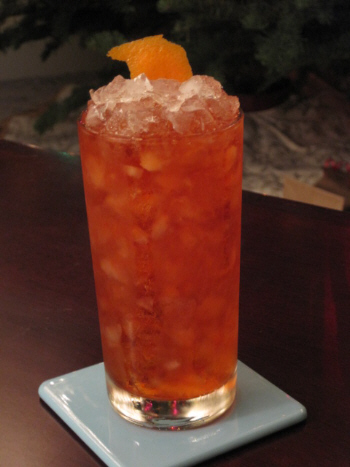
Anyway, now that you have the basic, where to go next? Let’s stick close to home while still getting ambitious: the Negroni Swizzle. The recipe is from Giuseppe Gonzalez at Painkiller in New York; I’d heard about the drink for a while, then a few weeks ago I saw the recipe on Tasting Table. I finally mixed one last night and, hell: it has everything that’s fantastic about a Negroni, but somehow more approachable. If you have a friend who’s still a bit Campari-phobic but is willing to try, this is a great way to get them to warm up to a Negroni.

Negroni Swizzle
by Giuseppe Gonzalez, Painkiller, New York

  • 1 ounce dry gin
  • 1 ounce sweet vermouth
  • 1 ounce Campari
  • 1 ounce club soda
  • 1 pinch salt

Fill a Collins glass with crushed ice. Add the ingredients, and using a bar spoon between your palms, spin the spoon in the mixture to combine and chill. Add more crushed ice — really, pack the fucking glass until the ice is mounded and the liquid threatens to overflow — and garnish with an orange wheel or, if you’re like me and didn’t leave enough room, a long, broad strip of orange zest carefully inserted down the side of the glass. Straw, please — and let it sit for a minute, to get a good frost on the outside of the glass.

The ingredients and proportions are the same as the original, with one exception: a pinch of salt (use sea salt or kosher salt; none of that iodized crap for the table). You don’t want a big enough pinch for the drink to taste salty; rather, you want it to function like a pinch of salt in a bowl of soup, where it just points up the other flavors without making its presence known.

There’s some club soda in there, too, which I’m not counting as an ingredient change since you get dilution anyway when you stir a basic Negroni, but between this dilution and the powerful chill that accompanies a swizzle, the drink’s intensity of flavor is softened — it still has everything you’re looking for in terms of Negroni flavor, but it’s not as heavy on the palate and the strong flavors aren’t as much in your face.

One other mixing note, however: the whole swizzle technique is used a lot when you have really powerfully flavored ingredients (like demerara rum) and/or high-proof ingredients (ditto). It’s worth keeping this tradition in mind when mixing a Negroni swizzle; if you have a higher-proof gin like Martin Miller’s Westbourne or, better yet, Plymouth Navy Strength, then go for it.

Okay, back to the vermouth: for anybody with bruised feelings over my dismissal of Carpano Antica for this drink (seriously, I know I’m gonna get comments and maybe a snide e-mail or two), here’s an exception: swap out the base spirit, and the Carpano may have its place.

I first came across the Agavoni in Robert Hess’ The Essential Bartender’s Guide, and wrote about this for Serious Eats in early 2009; since then the drink has made the rounds, popping up in the Washington Post and in Jason Wilson’s excellent new book, Boozehound, among other places. Created by German bartender / Traveling Mixologist / drinks writer Bastian Heuser, the Agavoni swaps out the gin for a silver tequila, which gives the drink a bright, peppery spark, against which a more lush vermouth such as the Carpano Antica works well. When Jason Wilson wrote this up for the Post, he suggested blancos such as Siete Leguas or El Tesoro; I couldn’t agree more on those recommendations.

Agavoni
by Bastian Heuser

  • 3/4 ounce blanco tequila
  • 3/4 ounce sweet vermouth – Heuser recommends Carpano Antica
  • 3/4 ounce Campari
  • 2 dashes orange bitters
  • – grapefruit twist, for garnish

Build in a rocks or old-fashioned glass filled with ice. Stir briefly to mix and to chill; garnish with a grapefruit twist.

And if you’re into the whole Negroni variation thing, don’t forget the Boulevardier. Enough said.

60/30, #34-36: In praise of hogo and the allure of funky rum

Hogo? Yeah, I’d never heard of it either.

Here’s how David Wondrich lays out the term in his new book, Punch, (which if you haven’t bought it yet or put it in a place of prominence on your Christmas list, I’m really wondering why you have any business reading this blog):

The Victorian free-love advocate Grant Allen defined it perfectly in one of his novels, when he has a West Indian planter explain: “it’s our common West Indian corruption … of haut goût – haut goût, you understand me … or hogo, being the strong and somewhat offensive molasses-like flavour of new rum, before it has been mellowed … by being kept for years in the wood and in bottle.” “Hogo” was a term of art in the rum trade since at least the beginning of the eighteenth century […] Derived from the term for the “high taste” of rotting meat, it could certainly be used perjoratively. But just as one cultivated the haut goût in pheasants and other game birds by hanging them for days before cooking them, so the hogo in rum came to be appreciated and even, to a degree, encouraged.

I’d long sought a word more apt than “funky” for that characteristic found in rum (and in relatives like Batavia arrack) that is typically caustic to a novice, but that functions as an aphrodisiac for the liquid libidos of true-blue rum junkies. This gamey, squirrelly, glandular musk found in certain rums makes you better understand why rum is so closely associated with pirates and seamen of yore; geography and trade routes aside, it’s hard to reconcile the high-culture character of the archetypical brandy sipper with the coarser nature of the seafaring type.

But a kind of rum that’s so enthusiastically stinky that it’s like a washed-rind cheese stuffed in a bottle, that you can smell a shot of from across a crowded bar and immediately identify it as the most aggressive and intimidating character in a three-block radius? Oh yeah, that stuff is pirate juice.

Hogo has been hard to come by. True, there was Pusser’s, which I hadn’t touched in years until I was recently served a cocktail made with it at Proof on Main in Louisville. Pusser’s is fine, but it never really excited me all that much; there was also Wray & Nephew White Overproof, which I’ve long used as the base for my falernum, but it just doesn’t have enough body to really push it into regular use.

A very different case can be made for Smith & Cross Traditional Jamaica Rum, which is cane-spirit fetish porn where hogo is concerned. I had my first experience with Smith & Cross at Tales of the Cocktail in 2009; Eric Seed was pouring advance tastes of this soon-to-be-released navy-strength product, and before he could even explain what it was – indeed, before I could even taste it – I could smell the rum from five feet away, and I was immediately in love.

Hogo-ish rum got another boost this past summer, with the debut of Banks Five Island Rum. I picked up a sample at last summer’s Tales of the Cocktail, but I foolishly left the sample bottle stashed away with all the other goodies I brought home from New Orleans and promptly forgot about it. It wasn’t until Wondrich’s piece on hogo and rum appeared in September’s Esquire magazine that I remembered I had the sample, and I immediately slapped it into a daiquiri. G’damn – there’s hope for white rum, yet, and the reason is in the blend: as I first learned from Wayne Curtis, one of the five islands in the name is Java, the ancestral home to Batavia arrack, a spirit that had hogo before there was a rum to get hogo about. Or something.

Anyway, enough chatter. Here are three drinks that take these rums for a nice spin.

Red Maple
by Jackson Cannon, Eastern Standard, Boston

  • 1 1/2 ounces Smith & Cross rum
  • 3/4 ounce fresh grapefruit juice
  • 3/4 ounce maple syrup (maybe less – to taste)
  • 2 dashes Peychaud’s bitters

Shake well with ice, strain into chilled cocktail glass.

Look familiar? It should – this drink is promoted from the comments section for my recent post on the Honey Fitz. As Jackson noted, this is the same drink proportions, subbing out the rum and the sweetener. I was pretty enthusiastic about the Honey Fitz, so how’d this fare?

Damn, no, yes, wow — owing to the navy-strength rum and its irrepressible skunkiness, this drink has a huge, gamy flavor, but the tartness of the grapefruit and the mellow richness of the maple make its funky character approachable and, indeed, embraceable. If you’re a Smith & Cross fanatic and you’re trying to explain to a relative neophyte why it’s such an essential part of the rum universe, this drink is a good vehicle to get them across to your way of thinking.

Speaking of Boston — here’s a drink that, perhaps bizarrely, is prominent in that city’s cocktail bars, but found relatively few other places: the Periodista.

It’d been a while since I tried one of these — I think not since the great apricot smackdown of whenever the hell that was — but at Tales last summer, I met Devin Hahn, who is trying to track down the story about this drink (check out Devin’s blog for more details). I mentally filed the drink away, meaning to come back to it, but didn’t until just a week or two ago, when Mike Dietsch blurted out his fanboy approval of the drink on Twitter, while trying a version from Misty Kalkofen that apparently was made with Smith & Cross.

This one isn’t with Smith & Cross. Recipes I’ve seen for the Periodista are split between those calling for an aged rum, and others calling for a white rum. Knowing how much I’ve enjoyed Banks in daiquiri-style drinks, I decided to give it a run in a Periodista.

Periodista

  • 1 1/2 ounces Banks Five Island white rum
  • 1/2 ounce lime juice
  • 1/4 ounce Cointreau
  • 1/4 ounce apricot liqueur
  • 1 tsp simple syrup

Shake with ice, strain into cocktail glass. Garnish with lime wedge or lime peel, if you’re so inclined.

From past experience I’d recalled this drink for its lively fruity interplay worked into a basic sour context. With the Banks rum in the driver’s seat, the drink has a bigger, burlier character; true, the tang of the rum’s hogo is hanging in the background, but that it’s present at all gives the drink more gravitas, and makes it grow up a bit more. An appealing alternative.

While thinking about this topic of hogo, and wondering what other drinks would illustrate it well, I came back to a cocktail I first learned about way back in ‘ought-four, when Ted Haigh first released Vintage Spirits and Forgotten Cocktails. Among the many drinks in that book that called for then-unobtainable ingredients, the Doctor Cocktail seemed particularly appealing: Jamaican rum, lime juice, and Swedish punch. I soon had an opportunity to try the drink, made with Appleton V/X and Carlshamm’s Swedish punch, and fell in like with it — still a basic variation on a daiquiri, but the richness of the rum and the subtle gaminess of the Carlshamm’s were kind of a fun diversion.

This is not the pleasant diversion recipe. With this big bottle of homemade punch in my liquor cabinet — made with the pure unadulterated hogo intensity of Batavia arrack — and a bottle of Smith & Cross right next to it, it seemed the obvious time to come back around to this drink and see what happens when you take it out on the metaphorical highway with a navy-strength rum and really open it up.

Doctor Cocktail
from Vintage Spirits & Forgotten Cocktails

  • 2 ounces Jamaican rum (Smith & Cross)
  • 1 ounce lime juice
  • 1 ounce Swedish punch

Shake with ice, strain into chilled cocktail glass, garnish with lime twist.

Ka-pow! The intensity of the aroma in this drink would likely kill a vodka-tonic drinker, so be careful where you wave this thing. The richness from the rum is still there, kinda, but this is a big bundle of talkative flavor that’s out for the evening and won’t lay off the horn. You don’t want to tuck into one of these every day, but when you do, you’ll remember it for a long time — and not just because your hair will still smell like funky rum for a week after imbibing one.

60/30, #32-33: Stone Fruit Sour and Don Bruno

I try to range around the country when searching for good new drinks, hitting up bartenders in Boston, San Francisco and New Orleans to get an idea of how things are working in other cities.

This means, though, that I’ve sometimes been guilty of ignoring what’s happening closer to home, with Seattle bartenders, and part of what I’m trying to do with this short-term obsessive blog project is to highlight drinks from a few folks around town who are doing wonderful things. I’ve already mentioned Jim Romdall and his take-no-prisoners approach to mixology; here’s a drink (a not incredibly recent one, though that’s my fault) from another excellent Seattle bartender whose work I don’t cover anywhere near enough: Zane Harris, from Rob Roy.

The last time I interviewed Zane for anything, it was about a year and a half ago, for a gin article I was writing for Imbibe. At the time, Zane was working at Vessel, and he gave me a couple of drink recipes that were dramatically different, but that were both incredibly engaging.

One of the drinks was the Stone Fruit Sour, a recipe that ran online but not in the pages of the magazine. A simple modification of a Corpse Reviver #2, the Stone Fruit Sour starts with the same model of equal parts gin, Lillet and fresh lemon, but in place of Cointreau Zane goes for the richness of apricot liqueur, and in place of the heady absinthe, a couple of dashes of peach bitters.

Stone Fruit Sour
by Zane Harris, Rob Roy

  • 3/4 ounce dry gin
  • 3/4 ounce fresh lemon juice
  • 3/4 ounce apricot liqueur
  • 3/4 ounce Lillet
  • 2 dashes Fee Brothers Peach Bitters

Combine everything in a cocktail shaker and fill with ice. Shake well about 10 seconds; strain into chilled sour glass or cocktail glass.

Before I go any further, I should note that today is Mixology Monday, hosted by Chris Amirault at eGullet, and Chris’s chosen theme is “Like That? You’ll Love This!” — in other words, sharing gateway drinks that can help usher the non-cocktail people in your life into your way of thinking. The last time an event with a similar theme came up, the drink I suggested was the Corpse Reviver #2, a flavorful and, in my mind, very approachable drink for beginners and committed cocktail enthusiasts alike.

If anything, the Stone Fruit Sour is even more easy to love; richer and fruitier where the CR2 can be lean and rangy, the Stone Fruit Sour seems tailor-made for drinkers accustomed to sweeter, fruitier, juicier drinks without a strong taste of alcohol, while itself avoiding (mostly) all of those descriptors. Sweet? Not really, but the liqueur provides enough richness that it’s sweet enough to get you there. Fruity? Hell, yes, but not in a cloying way. Ultimately, it’s just a perfectly balanced drink that touches on the peach / apricot / lemon comfort notes, but doesn’t sag into sticky insipidity like so many other drinks that venture down similar avenues.

Zane gave me another drink recipe to run with the gin story in 2009, one which actually did appear in print: the Don Bruno. Made with dry gin (Martin Miller’s Westbourne Strength is what you really want here), St. Germain and Don Bruno Sherry Vinegar, the drink has a complex, deep, eye-piercingly sharp flavor that doesn’t seem like it should work, but the combination really comes through.

The drink also has a problem — or, more accurately, I have a problem. A few months after the story came out, a bunch of us were at a dinner at Elemental in Seattle, a meal that featured pairings in which each course was matched with a drink made with Dolin vermouth. The drinks were created by various Seattle bartenders, along with non-bartenders including A.J. Rathbun and myself, and kicking everything off was an aperitif cocktail from Zane. I can’t recall the name that was stuck on the drink, but it was absolutely fantastic, and incredibly simple: nothing more than a splash of Don Bruno Sherry Vinegar tossed into an ice-filled mixing glass, swirled around and then poured off, followed by Dolin Blanc vermouth, stirred and strained into chilled glasses. Something about the sherry vinegar / blanc vermouth combo made it perhaps my favorite drink of the night.

And the problem? Last spring and summer I found myself with a hankering for these drinks, but I got lazy about checking the recipe. In my thinking, every time I thought of Zane’s Don Bruno cocktail, I forgot about the St. Germain and instead substituted Dolin Blanc, inadvertently mashing the two drink recipes together. An error on my part, I admit — but as I found out as this drink made it into occasional rotation in my house, it was a tasty, tasty error.

Don Bruno (mistake version)

  • 2 ounces gin (Martin Miller’s Westbourne – really, it makes a difference, but substitute Plymouth or another savory dry gin if you just can’t get it)
  • 1/2 ounce Dolin Blanc vermouth
  • 1/4 ounce Don Bruno Sherry Vinegar
  • – lemon twist, for garnish

Fill mixing glass with ice, and add vinegar. Stir a few seconds to splash the vinegar all over the ice; strain and discard excess vinegar. Add the gin and vermouth, and stir well until chilled, about 30 seconds. Strain into chilled cocktail glass; squeeze lemon peel over the drink and use as garnish.

The mistake version lacks the extra sweetness of the original, which is a better foil for the vinegar, but Dolin blanc has its own grape-ey sweetness, and just enough heaviness on the palate to counter the vinegar’s crisp bite. You really need to employ a light hand with the vinegar (or be vigilant about shaking out the excess), as it can easily screw everything up, but with its inimitable accent in the glass, it’s like a whole other class of bitters that lends depth and roundness to the finished drink.

Anyway, there’s one beginner-friendly cocktail for Mixology Monday, and one resolutely not a starter drink, both gathered (very long ago) from Zane Harris. While you’re online, go check out the other drinks from this month’s Mixology Monday, and once you’ve stepped away from the computer, go visit Rob Roy to see what else they’ve been up to.

60/30, #31-32: Cooling Cups and Dainty Drinks

I’ve always had a soft spot for older recipes, even when they haven’t worked out. For every eye-opening moment I’ve had with venerable drinks such as a Brandy Crusta or an Improved Gin Cocktail, there’s been an awkward pause after taking a sip of a gin punch (a version that didn’t work so well — there are others that do) or a yard of flannel. Time hasn’t treated much of the drinks world so well, but that’s as it should be — some drinks just don’t taste very good, and were made to be forgotten. Are they interesting from a historical perspective? Sure. But do they taste good? Hell, no.

So it’s with some measure of caution when I venture into old drinks books, but I long ago learned not to take recipes quite so literally. Yes, I try to hew to the original formulation as much as I can, and I’ll usually mix an according to Hoyle version of an old drink at first just so I know what I’m dealing with. But if vintage drinks function as windows into a bibulous past, it’s important to remember why those drinks were initially formulated. Some were designed as tonics or restoratives, others as aids to the appetite or digestion. But overwhelmingly, every drink ranging from prehistoric punches to contemporary cocktails has been designed for a reason: because it tastes good, and because it’s a flavorful way to efficiently get liquor inside you.

One vintage drink book I haven’t worked with all that much — primarily because I don’t own a hard copy, and have to rely on the version from Google Books (and I’m a sucker for hard copy, especially when it comes down to trying recipes) — is Cooling Cups and Dainty Drinks, by William Terrington. Published in London in 1869, Cooling Cups is of the same approximate vintage as that other leading text of classic mixology, Jerry Thomas’ Bar-Tender’s Guide. As its name implies, the book focuses primarily on that gauzy realm of drinks called “cups,” a category that calls punch its own but that also includes drinks made by flavoring and (sometimes) fortifying wine, beer and cider. While the book ventures somewhat into what we think of now as cocktail territory, with recipes for juleps, cobblers, a crusta and the like, we’re really talking mostly about larger-scale preparations.

As with any vintage drink guide, some of the recipes show their age, but you can see the underlying appeal of the drink through the creaky recipe. Here are two drinks that, as written, may not take you to many exciting places, but with a little fine-tuning, came out pretty well.

Let’s start with the easy one first: the ‘Tween Deck Cup.

‘Tween Deck Cup, or a Splitting Headache—

Put into 1/4 pint of rum 1/2 doz. crushed cloves, a little cinnamon, ginger, and nutmeg; strain in an hour, with pressure; add equal quantities of lime-juice, and 2 quarts of bottled ale.

Simplicity was the main appeal to me here, plus I’m a little enamored with booze-beer mixtures that work well. I kept mostly close to the original recipe, with a couple of significant exceptions: first, four ounces of rum to two quarts of ale? C’mon — at that point it’s just a glass of beer with a “does this taste funny to you?” air about it.

For flavoring, I followed the directions, except I used a few good chunks of stem ginger in syrup in lieu of fresh or dried ginger (why? because it tastes good, plus I had some), along with some whole cloves, coarsely crushed cinnamon sticks and a grating of nutmeg, all soaked in Zaya for a couple of hours, then strained. I made the beer-flavoring into more of a cocktail-style drink by shaking two ounces of the flavored rum with the lime juice and a little maple syrup (the other change, because otherwise it seemed just too acidic) with ice, then straining into a beer glass (I used a pilsner glass, as it seemed about the right size), and topping with a rich dark ale — maybe 3-4 ounces of beer, total, so the rum was still at the forefront of flavor. For the beer, I used Samuel Smith Winter Ale, what with it being Christmas-time and all, and this being essentially a spiced-rum drink, and the beer being the only thing that fit the bill currently in stock at my local store. So, to clarify:

‘Tween Deck Cup (updated version)
(makes two drinks)

  • 4 ounces rich rum – I used Zaya, but something like Zacapa or your other favorite big, dark rum should work well
  • 6 chunks stem ginger in syrup
  • 6 whole cloves
  • 1 cinnamon stick
  • Fresh-grated nutmeg – 6 scrapes or so, perhaps 1/8 tsp?
  • 2 ounces lime juice
  • 1/2 ounce maple syrup
  • Chilled rich ale

Muddle ginger in a soaking jar. Coarsely crush cloves and cinnamon and add to the jar with nutmeg and rum. Let soak for an hour or two, then strain. Shake the flavored rum with the lime juice and maple syrup; strain into two chilled beer glasses. Top with about 4 ounces (each) of rich ale.

And the verdict? Way, way better than I expected. Really, I thought this would be kind of “meh” and I don’t want to overstate things, because this won’t be my favorite holiday drink or anything, but really, it came out surprisingly good. The fresh spices came through better than any commercially produced spiced rum I’ve had (including the good ones), and the beer really meshed well, making this into kind of a more mature spiced rum and Coke, if that makes any sense at all. Anyway, I liked it.

And that was the easy one. Here’s where things got a little tricky, with a drink that doesn’t even have a name of its own.

Cider Cup a la Ensor, No. 4

Infuse in a gill of brandy, or whisky, 1 scruple of the essence of jargonelle pear (acetate of amyl), 2 dessert-spoonfuls of guava jelly, or quince; slice of cucumber, if desired, for a cool taste; quart of cider, bottle of perry, sugar to taste; add 3 bottles of lemonade or soda-water; ice up.

Okay, the thing that really got my attention here is the mention of “quince”. Like certain other people, I’ve become a BIG fan of quince brandy in recent years; even though it takes me a year to make a batch (though you can probably get somewhere passable within a couple of months), the combination of cognac and quince is almost aphrodisiacal to my palate. But, look at that train-wreck of a recipe — where to start?

Okay, I lobbed the spoonfuls of jelly in favor of using quince brandy for the base (if you didn’t have the foresight to prepare your own starting this time last year, then go with regular cognac and a barspoon of quince paste), along with an equal measure of bourbon, for more oaky depth. Lacking essence of pear, I opted for a lovely, lush German pear liqueur from Pur Spirits — this is without a doubt my favorite pear liqueur, with the ethereal flavor of pear eau de vie and the sweetness of fresh pears, a delicate liqueur but still with enough gumption not to immediately fade in flavor when confronted with other ingredients; really outstanding.

I added a little lemon juice, to compensate for what was becoming a sweet drink, and used honey syrup in lieu of sugar; also, for a little touch of spice, I added two dashes of The Bitter Truth Jerry Thomas Decanter Bitters. Finally, after shaking all that with ice, I strained into a cocktail glass and topped with maybe an ounce of chilled dry cider — I used Samuel Smith (again — based on availability, not necessarily preference; would be curious to try with other styles) — so think of this as a distant autumnal cousin of the French 75.

This was the drink I served on Thanksgiving; I think it worked well, with excellent flavors of pear, quince and apple, and a nice seasonal flavor without going overboard with cinnamon and other baking spices. If anybody wants to go all the way out there and mix one, please do let me know what you think.

Cider Cup a la Ensor, variation

  • 3/4 ounce quince brandy (substitute cognac)
  • 3/4 ounce bourbon
  • 1 barspoon quince paste (omit if using quince brandy)
  • 1/2 ounce lemon juice
  • 1/2 ounce Pur Spirits pear liqueur
  • 1/4 ounce honey syrup (equal parts honey and water)
  • 2 dashes The Bitter Truth Jerry Thomas Decanter Bitters (or substitute Angostura)
  • – chilled dry cider

Combine everything except cider in a cocktail shaker and fill with ice. Shake well until chilled; strain into chilled cocktail glass. Top with 1-2 ounces chilled dry cider.

I’m guessing there are about two people on earth who might actually try these recipes (and that’s a fairly generous guess), but if you decide to give either or both a try, please let me know.

60/30, #29-30: Friday = rye whiskey

It’s Friday at the end of a busy week, in the middle of a busy month. Complexity is not what I’m looking for in terms of drink preparation right now; lots of flavor, sure, and I’m still ready to do the basic shaking and measuring and whatever the hell I have to do to get a decent drink in front of me, but on Friday evenings I don’t really feel ambitious enough to make syrups or drag a half-dozen bottles out of the liquor cabinet for one drink.

I also don’t feel ambitious enough to go into a long, elaborate post about all the crooked crannies of complicated drinks, and I doubt you’re much in the mood for reading 1,000-word blog posts about a couple of cocktails, so let’s get right to the point: here are two whiskey drinks in the sour vein that I’m enjoying quite a bit these days.

New York Sour

  • 2 ounces rye whiskey
  • 3/4 ounce fresh lemon juice
  • 1/4 ounce simple syrup (or 1 – 1 1/2 tsp. sugar, to taste)
  • 1/2 ounce dry red wine (syrah, malbec – as long as it’s not sweet or big & jammy, you’re good)

Combine whiskey, lemon and sweetener in a cocktail shaker and shake with ice. Strain into an ice-filled rocks glass or a chilled cocktail glass. Carefully pour the wine over the back of a bar spoon so it forms a neat layer atop the drink (if you like, especially if you’re serving the drink straight up, you can chill the wine first by putting it in a mixing tin and placing that tin inside a larger glass or tin filled with ice).

Nothing new about this one — as David Wondrich write in Imbibe!, the drink was making the rounds during the 1880s, sometimes known as the Continental Sour or the Southern Whiskey Sour, but the New York Sour sobriquet stuck to it around 1900 (though I’ve also seen this on menus as a Greenwich Sour, and in books as a New York or New Yorker; shrug).

There’s also no surprise about why this is in my current rotation: it’s a tasty goddamn drink. I mean, look at it: it’s just a basic whiskey sour, a drink so classically awesome that it can do pretty much everything except explain to your wife why you’ve been out until 3am, topped with a float of red wine, which has the whiskey’s back and makes what would otherwise be a humble cocktail into something comfortable around high-class company. It looks great, it tastes fantastic, and if your kitchen is anything like mine you’ve probably already got all the ingredients. What more do you need?

Well, besides a second round: here’s another whiskey drink that Michael Bauer wrote up not too long ago for the San Francisco Chronicle: the Rattlesnake, from Beretta in San Francisco.

Rattlesnake
from Beretta, San Francisco

  • 2 ounces rye whiskey
  • 1 ounce lemon juice
  • 1/2 ounce maple syrup (Grade B is what you’re looking for)
  • 2 dashes Peychaud’s bitters
  • Egg white (one egg should be sufficient for two drinks)
  • – lemon peel, for garnish

Combine ingredients in a cocktail shaker and shake well, without ice, until the egg white is good and foamy, about 10-15 seconds. Add ice and shake again another 10 seconds; strain into chilled cocktail glass. Prepare your broad twist of lemon and go in for the kill.

Again, easy as hell: a whiskey sour with maple instead of simple, rendered old school with the egg white, and with a little bitters because what the hell, Peychaud’s is welcome at pretty much any party you can come up with. The drink comes out edgy and alluring (especially if you’re using a higher-proof rye like Wild Turkey or Rittenhouse bonded), with enough oaky darkness from the whiskey to beat off the richness of the maple and the acid from the lemon. The twist finish is somewhat unorthodox for egg-white drinks, but it works; the lemon oil winds up suspended on the drink’s surface for way beyond the first sip, so the heaviness of the rumble going on beneath the foam is never allowed to fully take over.

  • Liquor.com - Your expert guide to all things cocktails and spirits.
  • Archives

  • Subscribe via e-mail

    Enter your Email


    Preview | Powered by FeedBlitz
  • Categories

  • Support