

Entries Tagged as ''

Raiding the Louisiane

Raiders of the Lost CocktailSlipping in with just minutes to spare, one more entry for Raiders of the Lost Cocktail.

Anita chose Benedictine as the ingredient this round, and according to the ground rules:

* Each month, the [previous month’s winner] will select a cocktail ingredient, which is accessible but not currently in vogue.
* Each month, readers are invited and challenged to scour all published sources (old books, new books, red books, blue books… plus magazines, databases, matchbook covers) to find worthy cocktails that use this ingredient, and potentially merit revival and rediscovery.
* Entries must be previously published recipes, and include recipe, source, author, and when possible date of publication.
* Recipes don’t have to be unique to that publication.
* Entries will be judged on overall quality and appeal.
* Preference will be extended toward recipes which use relatively common ingredients, thus allowing this recipe to be prepared at a wider majority of bars.
* Preference will be extended toward recipes which are “simpler” in nature (i.e., fewer ingredients without a complicated or burdensome construction)

Well, color me repetitive, but when the topic is “Benedictine cocktails,” there’s one that always springs first to my mind, in part because it’s an intriguing once-forgotten classic, but also because it’s just so damn tasty that it’s usually on my mind to begin with: the Cocktail a la Louisiane.
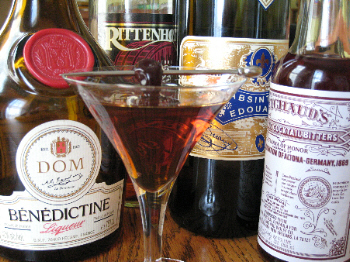
Cocktail a la LouisianeI first came across this drink while trolling in the backwater over at Chuck Taggart’s Gumbo Pages, but it wasn’t until I saw the recipe again, in Stanley Clisby Arthur’s Famous New Orleans Drinks and How to Mix ‘Em, from 1937, that I clued into the idea that I really should try it out. Y’see, at first glance the Louisiane looks like a sugar bomb — rye, a liqueur and sweet vermouth in equal parts, with a couple of dashes of pastis — but this is one of those drinks that has an alluring alchemy about it, that is able to rise above the level of mere sweetness and become something entirely new.

Interestingly, I’ve only ever seen this drink listed in one other cocktail guide: Bottoms Up, by Ted Saucier, which came out in 1951 (my copy, anyway); the recipe was near identical (everything was bumped up a notch in volume, but proportions remained the same). And then, nothing (though if someone’s spotted it in a guide that’s come out in the last couple of years, let me know) — which really astounds me, given the drink’s relative similarity to the Sazerac and Vieux Carre, along with its undeniable deliciousness.

One of the provisions for the Raiders challenge is that the ingredients be somewhat common, so a curious drinker would be able to order it in a bar. I think the Louisiane comes close: perhaps the most obscure ingredient in it is Peychaud’s bitters, which are popping up with greater frequency; rye isn’t too hard to find anymore, if you’ll go for Old Overholt, and practically everybody has sweet vermouth. There’s also room to goose up the quality of the drink: a few dashes of pastis are required, which in most bars means a little Pernod or Ricard; if you’re lucky, the bar will have some Herbsaint on a shelf, that adds a little extra authenticity to this New Orleans drink, along with a little ruggedness; and if you’re really lucky, your bar has supplemented its pastis selection with a bottle of Lucid or Kubler, genuine absinthes that will elevate the drink to another dimension.

Anyway, here you have it: my former favorite cocktail of Autumn 2006, now in my recurring list of favorite drinks of all time:

Cocktail a la Louisiane

  • 3/4 ounce rye whiskey
  • 3/4 ounce sweet vermouth
  • 3/4 ounce Benedictine
  • 3 dashes Pernod/Ricard/Herbsaint/absinthe
  • 3 dashes Peychaud’s bitters

Stir well with ice and strain into chilled cocktail glass. Garnish with a cherry.

* (and if the photo looks familiar, I snagged it back from a post I did on this drink for Serious Eats.)

Bright Lights, Big City, Beachbum Berry

If you’ve ever wanted to open the nation’s paper of record and find a big photograph of someone sipping an exotic drink while standing next to a giant tiki, you’re in luck with Wednesday’s Dining & Wine section.

Even better, that’s not just any someone — that’s Beachbum Berry with his mug in the New York Times. In “Cracking the Code of the Zombie,” the Gray Lady clues into the Bum’s significance with a lengthy profile accompanied by a handful of recipes, including the one for the original Zombie Punch. And if that isn’t enough, there’s even an interactive slide show, narrated by the Bum, on the history of tiki.

While drink-related stories are often buried in the depths of the Dining section, a quick glance at the Times’ website shows that the article is already the second-most e-mailed for today’s section — and it’s still Tuesday here on the West Coast. Mighty curious to see what the next 24 hours brings.

Good going, Bum — and if anybody still hasn’t picked up a copy of Sippin’ Safari you’d best grab one now, before Times-waving society matrons on the Upper East Side buy out SLG’s whole stock while planning a holiday luau.

Next One’s a Biggie

Mixology Monday The last Mixology Monday had the biggest turnout yet, and next week Jeffrey Morgenthaler will inherit the momentum when he hosts the last event of 2007, with the theme Repeal Day.

For those of you outside the U.S., the idea goes a little something like this: In 1919, booze was banned in the United States. Cue the stock footage of bootleggers, still-smashing by revenuers, big casks of beer being split open with axes, Al Capone’s goons wielding Tommy guns in the streets of Chicago. By 1932 cooler heads had prevailed, sending Franklin Roosevelt to the White House with a promise to repeal the 18th amendment (which institutionalized Prohibition in the Constitution), and which, with the help of Congress, he did, on December 5, 1933. Cue scenes of jubilant crowds waving pitchers of frothy beer, and Roosevelt mixing the first legal martini in the country (so I’ve heard). During that 13 year stretch, bartenders in the U.S. either changed profession, headed overseas to work the vibrant bars in London, Paris, Havana or other cities, or went underground and plied their trade in less-than-legal establishments. Regardless of the law, people did not go thirsty.

Jeffrey has been working to make this a festive holiday — check out the Repeal Day site he’s put together — and as part of the celebration, he’s inviting all MxMo participants to “write about a pre-Prohibition-era cocktail, tell a Repeal Day story, create an original drink inspired by Prohibition, etc.” That “etc.” leaves a lot of leeway, so have at it — just have your post up by Monday, December 3, let Jeffrey know about it (a comment in his announcement post is probably a good idea), and tune in for the results in the next day or two. And because Jeffrey’s so intent on making the event a big deal, he’s even supersized the logo for the event:

Mixology Monday

See you there.

* And, if you’re here in Seattle, Jamie also has BIG plans for December 5 at Vessel — check out his site for details.

General Harrison’s Eggnog

While retailers have been moving the start of the Christmas season progressively earlier each year, a few days before Thanksgiving Jeffrey Morgenthaler offered to help shoulder the burden by posting perhaps the first eggnog recipe of the season. Let the Yuletide drinking begin!

I still have plenty of supplies laid in from the autumnal drinks I’ve been socking away as of late, but here it is, the day after Thanksgiving, and I’m ready to help Jeffrey soldier on toward the holidays. How to ease the transition? How about a General Harrison’s Eggnog, a drink first written up by Jerry Thomas but helpfully reprinted (and elaborated upon) in — you guessed it! — IMBIBE!, by David Wondrich.

The General Harrison in the name, of course, was the old saddlesore commonly known to Whigs of the era and junior-high history students ever since as “Old Tippecanoe,” a reference to an 1811 Indian battle in which Harrison’s troops prevailed. While running for President in 1840, however, Harrison became known — in a positive way — for his drinking habits, which ran to hard cider. Depicted by his supporters as a simple man of the people, who lived in a log cabin and drank cider, Harrison went on to pummel the more patrician incumbent Martin Van Buren. Thomas wrote that this eggnog was Harrison’s favorite drink; considering that the old general dropped dead after just a month in office, the drink’s medicinal properties are probably mild.

I’d read the recipe for General Harrison’s Eggnog before, of course, but never had the slightest inclination to mix one. Consider: hard cider (artisan dry, for authenticity’s sake) and a whole egg, with only a little sugar thrown in to make the two get along. Now I’ve got nothing against a raw egg in my drink, but I’m accustomed to having the egg’s viscosity and richness broken up with a good jolt of something substantial — preferably a powerfully flavored aged spirit like whiskey or dark rum. Apple cider? It just didn’t seem to have the requisite gumption to get the drink going.

General Harrison's EggnogAnd this is yet another instance in which my foolishness has been revealed. Resigned to giving the drink its day in court, I mixed one up recently and — whaddaya know — it isn’t too bad. Not only not bad — it’s actually pretty damn good. The drink has a much lighter, crisper flavor than any other eggnog I’ve had, and without the contributions from the dairy aisle, it’s also much lighter in body. Thomas’ recipe is somewhat incomplete — “fill tumbler with cider” leaves a lot of room for interpretation — but I tried it out with four ounces of cider to one egg and 3 tsp of 1:1 simple syrup. I took my trusty Aerolatte to the egg before mixing, which helped liven up the consistency, and shook the drink hard in a cobbler shaker, which seemed less likely to blow apart than a Boston shaker when agitating an ingredient with a light carbonation.

But don’t just take my word for it — give it a shot yourself, in the waning days of autumn as we head into the holidays.

General Harrison’s Eggnog (adapted from IMBIBE! by David Wondrich)

  • 1 egg
  • 1 1/2 teaspoon sugar (or about 3 tsp simple syrup)
  • 1/2 glass of ice

Fill tumbler with cider [about four ounces] and shake well. “This is a splendid drink, and is very popular on the Mississippi river,” Thomas writes.

Genevieve

So, I guess everyone’s getting ready for the big feast on Thursday, and OH HELL, STOP THE PRESSES! THERE’S BIGGER THINGS THAN THANKSGIVING AFOOT!

That’s right — Fritz Maytag has been experimenting with his still again.

In case you don’t drink in San Francisco and haven’t read Erik’s blog lately, you may have missed the news that Maytag — the mastermind behind Anchor Steam beer (and its incredible Christmas ale, which I plan to start hoarding in the next few days), Junipero gin and the range of Old Potrero whiskies — has a new product coming out: Genevieve, a pot-distilled genever-style gin.

In typical Anchor fashion, Maytag has totally ignored the market trend toward lighter, less intense, gentle, floral gins, and instead is producing a robust spirit that, on first sip, had me thinking “chewy.” (Full disclosure: a sample was submitted and accepted for review). A quick primer for those unfamiliar with genever: if you hear the name “gin” and expect a crisp, dry spirit tasting of juniper, citrus and other botanicals, you’re gonna be mighty surprised at the first sip of genever (which also travels as Hollands gin, Geneva gin and Schiedam-style gin). Distilled at a lower proof than the neutral spirits used in London dry and Plymouth gins, the spirit has a much earthier, maltier, even funkier quality; match that with the botanicals (yes, the juniper is still there) and you’ve got a big wave of assorted flavors coming at you from the glass.

I love genever, though I haven’t had the chance to love it that much — I can only recall trying the jonge product from Boomsma, which more knowledgable palates than mine have pronounced “meh,” though I didn’t think it was too bad; Boomsma’s oude, which was more in the direction of a malt whisky than a gin; and the Bols genever, poured from a flask by Philip Duff, which left me with a great dichotomy of feeling: delight, at the rich malty character of the gin, and dismay that I’ll have to cross an ocean to buy a bottle.

So if genever won’t come to the United States, Maytag is willing to make his own, and we’re all the better for it. I had the pleasure of interviewing Maytag about a year ago while working on an article about rye whiskey for Imbibe, and I consider it a significant experience in some ways, in that he struck me as one of those people who is driven by a higher pursuit — not of profit or fame, necessarily, but of truth. It seemed to me that for Maytag, “truth” meant (at least in part) discovering the full potential of a spirit — exploring ways that grain can fully express itself through distillation and aging, and understanding how that expression can be harnessed for a more pure epicurean experience. The results can sometimes be academic, I’ll admit; I find the Old Potrero whiskies absolutely fascinating, for example, but they can also be bookish and intense rather than graceful and welcoming — while I’m always bowled over by the flavor, I rarely get a hankering to sit down and just sip at one (though the limited edition Hotalings is a notable exception).

But the result can also be as engaging as it is sensational — just look at Junipero — and I think the Genevieve falls into this category. Sure, it’s never going to be a top seller — c’mon, it’s genever, and even a top-flight version is going to have a very limited audience — but it is pretty damn good, and as Eric Seed is busy demonstrating over at Haus Alpenz, having a pretty damn good spirit that appeals to an admittedly limited audience of avid enthusiasts is still a very nice thing to have.

Genevieve gin

Genevieve uses a mash of malted wheat, barley and rye, and is distilled in a copper pot still with the same botanicals that appear in Junipero. Since it comes off the still at a lower proof, the spirit bears more resemblance, flavor-wise, to an unaged whiskey than it does to a neutral grain spirit like those produced by ADM and utilized in so many gins and vodkas you see. Bottled at 47.3 percent ABV, Genevieve comes up somewhat hot on the nose, but with a crisp juniper aura blended with the musty dryness of the rye and barley. Tasted neat, the gin is a bit intense, but with a few drops of water or a little quality time spent with an ice cube, the Genevieve softens up, presenting the “chewy” aspect I noted earlier, with the full flavor of the grain forming a light but firm base against the brighter, crisper notes of the juniper, citrus and other botanicals.

As David Wondrich notes in Imbibe! — which you’ve all purchased by now, right? Well, what are you waiting for? — many of the vintage cocktails prepared during mixology’s baroque era were constructed using Hollands gin (and before anyone chimes in with a correction — how ya doin’, Erik — Wondrich does note that the lighter, jonge-style genevers are a relatively recent phenomenon, and that the old recipes had the heavier, oude-style genever in mind. In my admittedly limited experience, I would think Genevieve bears more in common with a jonge genever than a corenwyn or oude genever. Still, it’s here, it’s good, and as Wondrich also notes, “[jonge genever] still makes a far richer and tastier plain Cocktail than the lighter English gins,” so go ahead and give it a shot.)

I’ve only tried Genevieve in one drink so far, the Improved Gin Cocktail (the recipe for which is slightly different than the one Wondrich ran in Killer Cocktails, and that I wrote up a long time ago using Boomsma), but it came through beautifully, the flavors of the absinthe, maraschino and bitters adorning the base like a Christmas tree. Geneveive and other genever-style gins may not be nearly as versatile as the more common London drys, but as long as I can mix a few of these divine cocktails, I’m happy to spend the time, money and effort to keep genever stocked in my liquor cabinet.

Improved Gin Cocktail (adapted from IMBIBE! by David Wondrich)

  • 2 dashes Angostura bitters [I decided to use Peychaud’s, to good effect]
  • 1 tsp simple syrup (even better if it’s a rich demerara syrup, 2:1 sugar to water)
  • 1/2 tsp maraschino liqueur
  • 1 dash absinthe (I used Jade Edouard — what the hell, good booze meets good booze, and I’m the big winner)
  • 2 ounces Hollands gin

Stir well with ice and strain into a chilled cocktail glass; twist a piece of lemon peel over the drink. As Wondrich notes, “to contemplate it is to desire it.”

  • Etcetera

  • Powered by Laughing Squid
  • hit counter