
 Ah, the twists and turns of time.
It seems like only yesterday the boozy blogosphere was bouncing along in its stroller, its fat cheeks still rosy with the blush of gin (and youth). But today, the online bar world is showing every sign of age, its bald spots and love handles collected over the course of years.
In the spring of 2006, a time when you could fit every cocktail blogger in the world at the same dining room table (and still have a spot open for Elijah), I thought it might put some sociability into social media if we could pull off the closest thing we could manage to a cocktail party, considering that we were arrayed around much of the globe. Always a fan of the power of alliteration, I dubbed the thingy “Mixology Monday†and sent out the invitations. A respectable half-dozen or so responded to MxMo I—including bloggers like Darcy O’Neil, who still hangs around the booze world in various capacities, and Rick Stutz from Kaiser Penguin, who doesn’t really anymore (though as I learned during a surprise encounter with the Kaiser recently at Death & Co., he’s lost none of his enthusiasm for funky rum)—and since nobody shattered the stemware or pocketed the silver at that first party, a changing crowd of bloggers (I passed the hosting and moderating reins to Fred Yarm at Cocktail Virgin Slut a few years ago) has kept the thing rolling on and on as the roman numerals piled up.
When I talked to Fred in New Orleans last month, he reminded me that the 100th round of this online cocktail party was coming up fast, and needled me to participate. And when he went on to theme this milestone MxMo C after my book—well, what else is there to do but raid the liquor cabinet once more for old time’s sake?
Fred’s aiming at simplicity for this MxMo, and that’s a theme central to the recipes in “The Cocktail Chronicles
So how does a contemporary drink both tap into the wonders that have come out of the recent cocktail renaissance, while hewing close to the code of simplicity? Here’s one recommendation: the GT Swizzle.
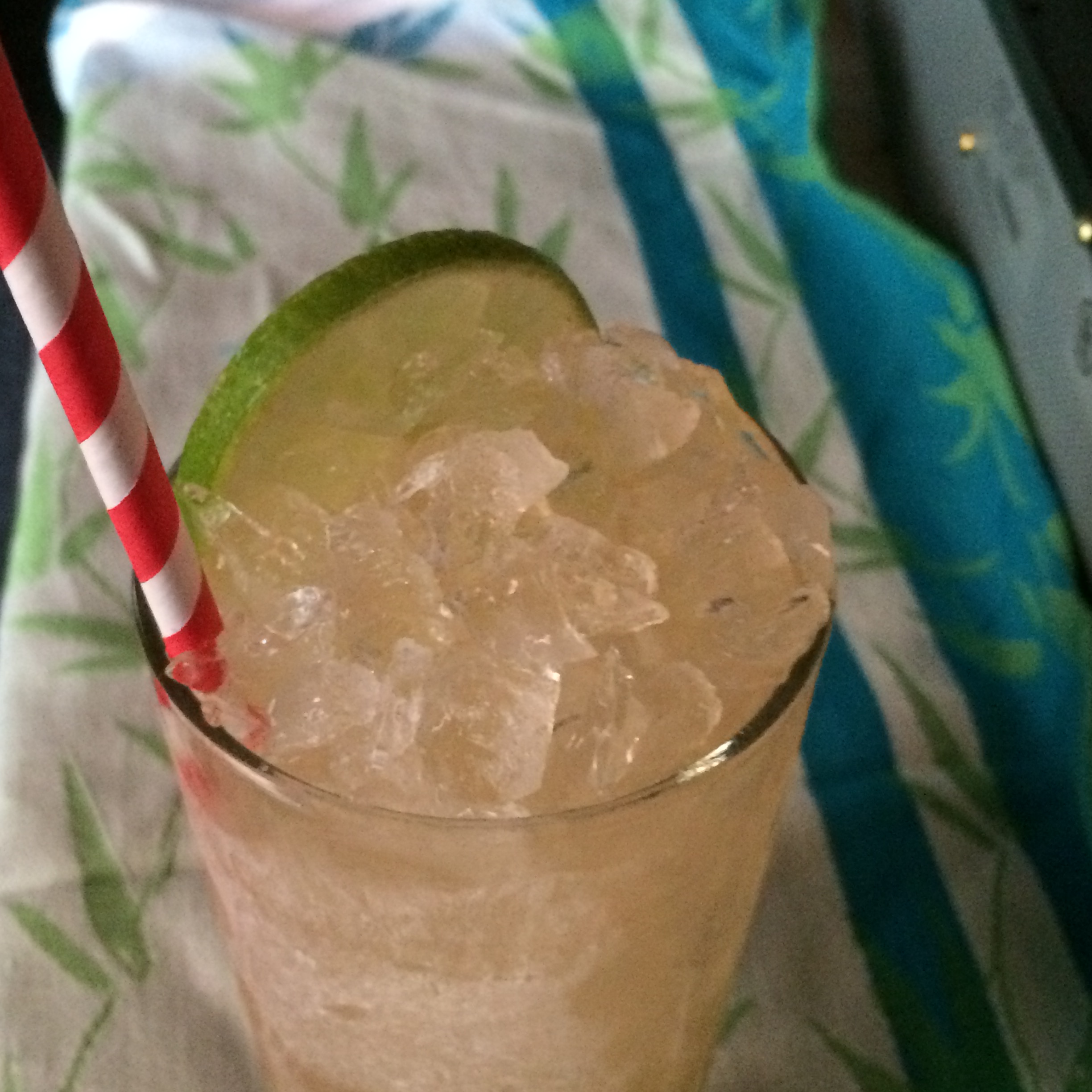 On the one hand, the GT Swizzle is nothing more than a Gin & Tonic (an unfizzy one at that), one of the most simple drinks in cocktaildom and one that’s lost none of its power of refreshment (especially during a summer that’s seen the hottest July on record). But while the average G&T can be an ignoble thing—slopped together in a glass or plastic cup with a glug of well gin and a sploosh of tonic from a soda gun or a plastic liter bottle—an advanced G&T can be a cornerstone of civilization.
While meditating on the G&T one night, I wondered how it might be possible to make a drink that provides such bounteous refreshment—well, even more refreshing. To that end, I tapped another forceful heat-busting style of drink, the swizzle, composed of a few basic ingredients and (importantly) a flurry of crushed ice, which is then whirred together in such a way as to supercool the drink and, by extension, the drinker.
Most traditional swizzles are based on rum—and, it should be noted, a higher-proof rum, which is tempered by the dilution provided by the ice, but which also brings enough robustness of aroma and flavor to withstand such dilution. Following this theme, I reached for a Navy-strength gin—a potent expression of the spirit that was pretty much absent from the bar a decade ago, but is now well-represented on the shelf, with bottlings such as Plymouth Navy Strength, Hayman’s Royal Dock (which I used in this drink) and Perry’s Tot, along with the wonderfully expressive Sipsmith VJOP (very juniper, over-proof), which I imagine would make a slam-dunk GT Swizzle.
Traditional swizzles also typically utilize citrus, which is fortuitous as the standard G&T often benefits from a healthy squeeze of lime. The tastiest Gin & Tonic I recall lapping a lip over was prepared by Toby Cecchini, who added bits of the fruit (peel and all) to his pitcher while preparing the drink; to this end, when preparing the GT Swizzle, I sliced off a couple of thin wheels of lime and added them to the glass along with the other ingredients, to throw their charm into the mix.
Swizzles also often include another potent-flavored modifier, such as mint. For the GT Swizzle, I swapped the G&T’s usual tonic water for tonic syrup (in this case, Yeoman’s Tonic Syrup from Jennifer Colliau’s Small Hand Foods), as it provides the amplified tonic flavor I’m looking for, without the added dilution from the soda water (since ice-melt from the swizzle has got that base covered—though you could instead use your favorite tonic water, just be moderate with the dosage or else you’ll swamp the ice-rich power of the swizzle). And as the final accent to the drink, I added a couple of dashes of The Bitter Truth’s Tonic Bitters, a bang-up recent addition to the bitters shelf from one of the masters of the bitters craft.
The result? An icy handful of refreshment that lets its G&T flag fly, simple enough to put together using products now widely available, and familiar enough in flavor to sip all summer long.
GT Swizzle
2 oz. overproof gin
½ oz. fresh lime juice
½ oz. tonic syrup (or tonic water, to taste)
2-3 dashes tonic bitters (optional)
a hell of a lot of crushed ice
3 thin wheels fresh lime (save one as garnish)Add liquid ingredients (except bitters) to a Collins or chimney glass and fill halfway with crushed ice. Nestle two of the lime wheels against the interior of the glass, and add crushed ice to hold in place and to fill. Use a swizzle stick or a barspoon to swizzle the drink, combining the ingredients and chilling the mix until a thin film of ice coats the outside of the glass. Add more crushed ice to fill, and stick that final lime wheel into the ice as garnish; dash your bitters atop the thing as you desire, and spear with a straw. If you can hold back for a moment, let the drink rest for a minute or two, during which time a thicker layer of ice will build up on the outside of the glass, which on a steamy August day is just awesome.
100 rounds of Mixology Monday—wow, y’all, that’s fantastic. Thanks so much to Fred for keeping this thing alive for so long – and head on over to his site for a roundup of this milestone event.
